
Evidence record
The Psychology of Money — technical appendix
The chapter assessments, claim audits, source checks, and scoring behind the review.
Evidence and editorial record for The Behavioral Scientist. This appendix records the research, judgments, and verification limits behind the review. It does not claim independent human scientific review.
Evidence cutoff: 15 September 2026, limited to material actually accessed. The cutoff does not certify an exhaustive search of every source or of publications released that day. The reader review is here, the machine-readable record is here, and unresolved work is collected in research limits.
Headline adjudication: Scientific Accuracy 58%; Reference Accuracy 58%; Practical Value 75%; overall 64%. The nine inputs are 2, 3, 2 / 3, 2, 2 / 3, 3, 3. These are editorial anchors, not measured percentages of truth, financial efficacy, or author reliability.
Contents
Common claim register
The register precedes the twelve substantive sections. Supported, Partly supported, Overstated, Incorrect, Unresolved, and Practical judgment are navigation labels, not additional scoring inputs. An “Incorrect” label is confined to the specified subclaim; “Unresolved” is never counted as an error. Conditional arithmetic findings retain the assumptions and alternative readings in their dossiers.
There are 76 book-claim records, 20 reviewer-origin claim records, and 77 separately labeled book-reference entries in the CSV: 173 records total. These are not 173 independently verified empirical claims. Several book records deliberately group a chapter’s unverified contextual material. No count is converted into an error rate for the book.
| ID | Origin | Scoped subject | Navigation assessment |
|---|---|---|---|
| B-I01 | Book | Behavior matters more than intelligence or formal financial knowledge for doing well with money. | Partly supported |
| B-I02 | Book | The opening recounts Read’s wealth and philanthropy and Fuscone’s financial collapse, including specific death counts, property values and dates. | Partly supported |
| B-I03 | Book | Modern financial sophistication has not demonstrably improved ordinary personal-finance behavior, in the author’s assessment. | Overstated |
| B01-01 | Book | Lifetime economic experiences influence investment risk-taking; early adult experience is emphasized. | Partly supported |
| B01-02 | Book | Differences in risk-taking are attributed to birth experience rather than intelligence, education or sophistication. | Overstated |
| B01-03 | Book | Low-income lottery spending and emergency-expense difficulty predominantly describe the same people. | Overstated |
| B01-04 | Book | 40% cannot raise $400 in an emergency. | Incorrect |
| B01-05 | Book | Different cohorts experienced sharply different inflation and investment environments, and later retirement became more common. | Unresolved |
| B01-06 | Book | Understanding a decision’s context does not make it well-informed or financially wise. | Supported |
| B02-01 | Book | Gates’s unusual educational opportunity and Evans’s early death illustrate the importance of luck and risk. | Partly supported |
| B02-02 | Book | Brothers’ incomes are more correlated than height or weight. | Partly supported |
| B02-03 | Book | Do not equate financial outcomes with effort; extreme winners may be poor models to copy. | Practical judgment |
| B03-01 | Book | Insatiable comparison can lead people with adequate resources to risk what they need for what they do not need. | Practical judgment |
| B03-02 | Book | A hypothetical 5% annual return on $100 million produces almost $600 per hour. | Supported |
| B04-01 | Book | Time greatly magnifies wealth when positive returns compound. | Partly supported |
| B04-02 | Book | The hypothetical 30-to-60 accumulation yields $11.9 million. | Incorrect |
| B04-03 | Book | Different compounding durations explain the wealth contrast between Simons and Buffett. | Unresolved |
| B04-04 | Book | Small persistent changes and nonlinear growth can yield very large consequences. | Unresolved |
| B05-01 | Book | Survival, restrained leverage and liquidity allow a person to remain invested through adverse conditions. | Partly supported |
| B05-02 | Book | Cash can be worth more to a financial plan than its stated interest yield. | Practical judgment |
| B05-03 | Book | US living standards grew despite repeated severe disruptions. | Unresolved |
| B06-01 | Book | Four in ten public companies experience a catastrophic loss, illustrated as a complete wipeout. | Partly supported |
| B06-02 | Book | Seven percent of component companies account for effectively all index returns. | Overstated |
| B06-03 | Book | Technology 57%, telecom 51%, energy 47%, consumer discretionary 43%, health care 42%, industrials 35%, materials 34%, staples 26%, financials 25%, utilities 13%. | Supported |
| B06-04 | Book | Reported terminal balances are $435,551, $257,386 and $234,476. | Unresolved |
| B06-05 | Book | Extreme successes can dominate portfolios; numerous specific empirical illustrations are supplied. | Unresolved |
| B07-01 | Book | Perceived control is the most dependable lifestyle cause of happiness beyond objective advantages. | Overstated |
| B07-02 | Book | Unspent assets can buy options and control over time. | Practical judgment |
| B07-03 | Book | Greater consumption and reduced control over time explain why Americans are not happier despite richer circumstances. | Overstated |
| B07-04 | Book | Older interviewees valued relationships and time rather than money-focused status goals. | Partly supported |
| B08-01 | Book | Expensive possessions generally fail to produce the desired admiration because observers imagine owning them instead. | Partly supported |
| B08-02 | Book | Readers may enjoy expensive goods while being cautious about expecting admiration from them. | Practical judgment |
| B09-01 | Book | Visible consumption does not reveal retained financial assets and financial flexibility. | Partly supported |
| B09-02 | Book | Buying a car leaves less cash or more debt, so the purchase alone cannot reveal how wealthy the buyer is. | Supported |
| B09-03 | Book | Overspending reduces financial reserves; exercise can be offset by eating. | Partly supported |
| B10-01 | Book | Above some income level, savings rate dominates income and returns in wealth accumulation. | Partly supported |
| B10-02 | Book | Above relatively modest material needs, additional spending primarily reflects ego, and reducing desire is largely controllable. | Overstated |
| B10-03 | Book | Unallocated savings can serve useful future needs even without a named purchase goal. | Practical judgment |
| B10-04 | Book | Efficiency overcame resource constraints; flexibility now provides a more sustainable advantage than intelligence. | Unresolved |
| B11-01 | Book | A tolerable strategy may be preferable to one a person abandons, despite a superior spreadsheet projection. | Practical judgment |
| B11-02 | Book | The stated borrowing ratio and wipeout percentage describe the same two-to-one leveraged account. | Incorrect |
| B11-03 | Book | The cited researchers reported a 90% expected retirement-wealth advantage over life-cycle funds. | Supported |
| B11-04 | Book | Attachment and small discretionary investing can help someone sustain the rest of a diversified plan. | Practical judgment |
| B11-05 | Book | Fever can help fight infection, but treatment must account for tolerability. | Unresolved |
| B12-01 | Book | Historical market experience does not set guaranteed bounds on future events. | Practical judgment |
| B12-02 | Book | Seven out of 15 billion is 0.00000000004%. | Incorrect |
| B12-03 | Book | A small set of surprises and structural changes explains much of modern financial history. | Unresolved |
| B13-01 | Book | Buffers improve a plan’s ability to survive deviations from expectations. | Practical judgment |
| B13-02 | Book | The author plans using future returns one-third below his quoted historical average. | Supported |
| B13-03 | Book | Repeated exposure to a 5% downside makes encountering it nearly certain over a lifetime. | Overstated |
| B13-04 | Book | Examples support reserving resources for unexpected outcomes. | Unresolved |
| B14-01 | Book | People underestimate future personality, preference and goal changes. | Partly supported |
| B14-02 | Book | Avoid extreme plans and permit justified changes of mind to reduce regret and sustain progress. | Practical judgment |
| B15-01 | Book | Treating volatility as a cost of a potentially worthwhile investment can support endurance. | Practical judgment |
| B15-02 | Book | Tactical funds generally disappointed in the chosen interval, and fund investors lost about half a percentage point to timing. | Unresolved |
| B15-03 | Book | Smooth-looking performance can conceal risk; large gains have coexisted with drawdowns. | Unresolved |
| B16-01 | Book | Taking cues from investors with different horizons can contribute to bubbles and poor decisions. | Practical judgment |
| B16-02 | Book | 120% annual turnover bounds investors’ horizons at eight months. | Overstated |
| B16-03 | Book | Specific trading, flipping and valuation examples illustrate shrinking horizons. | Unresolved |
| B17-01 | Book | Pessimistic stories gain disproportionate attention and often overlook adaptation. | Partly supported |
| B17-02 | Book | More than half of US households directly own stocks. | Incorrect |
| B17-03 | Book | Progress and adaptation can be overlooked because they unfold slowly. | Unresolved |
| B18-01 | Book | Changed economic narratives were the decisive cause of the 2007–2009 crisis, despite largely intact physical productive capacity. | Overstated |
| B18-02 | Book | High stakes and a desire for an outcome can foster selective interpretation. | Practical judgment |
| B18-03 | Book | Specific comparisons illustrate poor economic forecasting versus precise physical prediction. | Unresolved |
| B19-01 | Book | Advice must be applied to the reader’s own aims; financial advisers can know useful principles without knowing every person’s priorities. | Supported |
| B19-02 | Book | Increasing time horizon is the most powerful investing improvement, though it cannot eliminate luck and risk. | Partly supported |
| B19-03 | Book | A coherent set of principles favors reserves, humility, endurance and personally meaningful use of money. | Practical judgment |
| B20-01 | Book | The author chooses a debt-free home and substantial cash for personal independence and explicitly does not prescribe his cash allocation to everyone. | Supported |
| B20-02 | Book | Regular low-cost diversified investing is the author’s preferred route and, he thinks, best for most readers’ long-run goals. | Partly supported |
| B20-03 | Book | The household’s savings approach depends on shared preferences and growing income as well as restraint. | Supported |
| B20-04 | Book | Advisers’ or doctors’ personal choices can differ from recommendations to others. | Unresolved |
| B-P01 | Book | Postwar prosperity and shared expectations, followed by inequality, helped produce consumer borrowing and discontent. | Partly supported |
| B-P02 | Book | Displayed debt rises from $29.4bn (1945) to $125.7bn (1955) and $331.2bn (1965); new homes get larger. | Supported |
| B-P03 | Book | The historical and political narrative acknowledges unequal rights and rejects reducing political change to inequality alone. | Supported |
| B-P04 | Book | Contemporary conditions described in the postscript are conditions around writing/publication. | Unresolved |
| R01 | Reviewer | The ebook copyright distinguishes ebook ISBN 9780857197696 from paperback ISBN 9780857197689. | Supported |
| R02 | Reviewer | The accessed Malmendier–Nagel evidence supports an experience/risk-taking relationship, not a relative causal ranking of behavior, IQ and income in wealth. | Supported |
| R03 | Reviewer | Hypothetically, $40,000 after-tax income at a 20% saving rate yields $8,000; $200,000 at 10% yields $20,000. | Practical judgment |
| R04 | Reviewer | Financial-education programs have favorable average results in a 2020/2022 synthesis, while a later reanalysis challenges the estimated behavioral magnitude. | Supported |
| R05 | Reviewer | At a hypothetical constant 5% annual return, $10,000 becomes approximately $43,219 in 30 years before taxes/costs. | Practical judgment |
| R06 | Reviewer | Sharpe’s aggregate arithmetic and historical brokerage results support avoiding unnecessary costs, but not the claim every active manager loses. | Supported |
| R07 | Reviewer | JPM’s catastrophic threshold and 7% extreme-winner classification use different estimands from bankruptcy and total-index-return attribution. | Supported |
| R08 | Reviewer | Bessembinder’s 4% finding concerns net dollar wealth creation above a Treasury-bill counterfactual. | Supported |
| R09 | Reviewer | Broader international historical simulations do not make long-horizon stock investing risk-free in real terms. | Supported |
| R10 | Reviewer | The relevant Fed emergency-expense category and Gallup ownership statistic differ from Housel’s descriptions. | Supported |
| R11 | Reviewer | Three-times gross exposure and two-times gross exposure have different pre-friction wipeout thresholds. | Practical judgment |
| R12 | Reviewer | A small 2017 experiment found improved same-day mood after funded time-saving versus material purchases. | Supported |
| R13 | Reviewer | A 2022 study adds a small favorable buying-time association in new survey data, not an experimental replication. | Supported |
| R14 | Reviewer | Swedish lottery-wealth research reports durable life-satisfaction effects and smaller, statistically uncertain overall-happiness and mental-health effects. | Supported |
| R15 | Reviewer | Luxury signals can affect perceptions or treatment in some experiments, but an extended replication produced a different pattern. | Supported |
| R16 | Reviewer | The end-of-history literature includes an original personality comparison, a life-satisfaction adaptation and same-data disagreement over estimands. | Supported |
| R17 | Reviewer | Financial conditions can deteriorate without the destruction of all physical productive capacity. | Supported |
| R18 | Reviewer | Cash, mortgage repayment, saving and time-saving purchases involve liquidity, opportunity-cost and horizon trade-offs. | Practical judgment |
| R19 | Reviewer | No direct test of the effect of reading The Psychology of Money was accessed in this review. | Supported |
| R20 | Reviewer | Scientific Accuracy inputs [2,3,2], Reference Accuracy [3,2,2], and Practical Value [3,3,3] total 23/36: overall 63.888…%, category displays 58%,58%,75%. | Practical judgment |
01 · Verdict in context
Recommendation: a useful financial philosophy and selective set of principles; not a stand-alone technical financial plan or a settled causal theory of wealth and happiness. The book’s emphasis on avoiding ruin, limiting unnecessary costs, tolerating portfolio-level disappointments, and matching a plan to its owner has substantially stronger support than its broad rankings of behavior over knowledge or time control over other sources of well-being.
Intended use: interested nonspecialists deciding what to believe or apply. The most plausible fit is a reader with some discretionary saving capacity who is vulnerable to lifestyle escalation, excessive investment activity, or fragile planning. Readers facing insufficient income, imminent spending needs, or complex debt and insurance problems require information this book does not supply. That is a scope limit, not a demand that a philosophy book include every technical subject.
Confidence: high in the book-text comparisons, identified survey-definition differences and executed arithmetic; moderate in the nine editorial grades; lower in exact biographical, historical and financial-series details left unresolved. Evidence about practical components does not establish a measured effect of reading the book. No quantitative reader-benefit or harm probability is estimated.
Ease of application, unscored: the prose and principles are accessible. Maintaining surplus income, agreeing on household priorities, surviving losses, and sustaining a plan can be difficult. Readability neither raises nor lowers the numerical scores.
02 · Scope and method
Edition and reading scope
The reviewed object is Morgan Housel’s The Psychology of Money: Timeless Lessons on Wealth, Greed, and Happiness, Harriman House, first published in 2020. The supplied EPUB’s actual publishing-details page identifies eBook ISBN 978-0-85719-769-6 and paperback ISBN 978-0-85719-768-9. These identify different formats; the ebook metadata and the paperback number are not conflated. No print page numbers are assigned to this EPUB.
The complete supplied extraction was read, including introduction, all twenty numbered chapters, postscript, notes, acknowledgements and publishing details. Programmatic inspection confirmed 51 EPUB spine entries. A whitespace count of the directly parsed spine text was approximately 52,888 words, whereas the supplied extraction was described as approximately 52,687. Tokenization and extraction conventions differ; neither approximate count is presented as a critical edition’s exact word count. The spine manifest was checked for coverage rather than using the small count difference as evidence of missing material.
The EPUB contains 37 distinct image assets. All were visually surveyed; all nine substantive visuals received legible inspection, with a direct comparison of the book’s sector-loss chart to the JPM report. The remaining assets are cover/title/section graphics. Source data underlying most charts were not recovered. Section 10 distinguishes what was seen from what was numerically reproduced.
Public book locators use genuine chapter names, subheadings or identifiable passages. Internal spine identifiers are retained only for auditability. They are not print pagination. The supplied text and EPUB are research inputs and are not redistributed in this package.
Selection and audit design
The three central propositions below were saved after full-book reading and before external weakness searches or score assignment. Selection is purposive and prospective within this assignment, not random and not a preregistered systematic review. The complete record is preserved verbatim in section 4. No proposition was revised after searching.
The external source audit is consequential and purposive. It prioritizes the three central propositions; named studies used to explain them; high-stakes investment implications; and numerical or measurement claims likely to alter a reader’s understanding. Faithful examples are retained alongside problems. Each substantive chapter receives a separate assessment. This is complete chapter coverage, not independent verification of every factual sentence or every one of the 77 endnotes.
Evidence was sought through web search, Exa search/fetch, author/institutional manuscripts, journal pages and official survey reports. Several web requests failed or returned generic pages; alternative retrieval was used when possible. A retrieved abstract supports only abstract-level conclusions. Complete main-text access does not imply that supplements, raw data, preregistrations or every figure were inspected. Actual access is recorded source by source in section 11 and the CSV.
Appropriate evidence, not one design for every question
Mathematical compounding, balance-sheet identities and conditional leverage arithmetic do not require randomized trials. A personal preference for independence does not require experimental validation. A description of an anecdote is not evidence of a general causal effect, and a predictor of well-being does not automatically establish an intervention that increases it.
For financial quantities the audit separates dollar wealth from income and savings rates; nominal from real values; arithmetic averages from compounded returns; cumulative multiples from annualized rates; losses from a prior peak from terminal bankruptcy; and fund returns from investor cash-flow-weighted returns. Claims made at the book’s writing date are not treated as false because markets or fortunes subsequently changed.
Search chronology and review operations
Full-book and guide reading preceded the frozen claim selection. External searching then examined affirmative evidence and weaknesses, including later adaptations and original-author responses. A late-stage targeted notice search identified the Fernandes–Lynch–Kim challenge to the financial-education synthesis; it was added to the evidence record and the reader essay, not omitted to preserve a simpler argument. This changed the strength of the reviewer’s education counterargument, not the wording of the three selected claims. Grades were assigned to the complete first-draft evidence record.
Deterministic arithmetic was executed locally with Python Decimal calculations. No author backtest, participant-level model, CRSP analysis, clinical dataset or economic simulation was independently reproduced. Local validation checks cover record consistency, links and arithmetic, not independent scientific peer review.
The supplied house rubric is followed exactly: three central-claim inputs for Scientific Accuracy; traceability, accurate description and warranted inference for Reference Accuracy; intended benefit, applicability/durability and benefits versus burdens/risks for Practical Value. Each integer is 0–4. There are no bonuses, caps or automatic deductions per discrepancy. NR/NA would withhold the affected category and overall score; none was assigned because the available record permits bounded criterion judgments despite identified source gaps.
03 · Strongest fair reading
The strongest reading is not “psychology replaces finance.” It is that financial advice fails when it assumes the human being implementing it is an emotionless optimizer. A person’s history affects what risks feel acceptable. A household must survive interruptions and surprises. A lower-return plan that can actually be maintained may beat an ambitious plan that is abandoned. Financial resources can be valuable because of what they let someone refuse, not simply what they buy.
Several qualifications materially improve this argument. In the Introduction, Housel says the technical tools are not bad or wrong. “No One’s Crazy” acknowledges misinformation and bad mathematics and calls lottery purchases a bad idea when broke. “Luck & Risk” rejects attributing all outcomes to effort and explicitly warns against copying extreme winners. “Save Money” begins with an income qualification. “You’ll Change” warns against excessive austerity as well as excessive work. “Nothing’s Free” explicitly denies a guaranteed payoff from bearing volatility. “You & Me” introduces its bubble explanation as one possible reason rather than a complete theory. “All Together Now” acknowledges that an adviser does not know an individual reader’s aims. “You & Me” also recognizes that a young lawyer may benefit professionally from maintaining an appearance that Housel, as a writer, has no reason to copy.
“Confessions” makes the clearest distinction between general principles and personal implementation. Housel’s household owns low-cost US and international index funds, not a permanently concentrated bet on a few favorite companies. He says indexing is not infallible or universally suitable. He explicitly does not recommend his roughly 20% cash allocation to everyone. His frugal lifestyle depends on both spouses wanting it, and rising income helps finance the high saving rate. His debt-free home is described as a chosen preference for independence, not an empirically optimal strategy for all readers.
These caveats are credited in the grades. They do not automatically neutralize the book’s stronger claims that behavior matters more than knowledge, that wealth building has little to do with income, that a longer horizon is the single most powerful investing improvement, or that control over time is the broadest lifestyle cause of happiness. A fair reading preserves both the qualifications and the comparative assertions.
04 · Central claims
Preserved initial selection record
The following record is reproduced unchanged. Its SHA-256 is 20ca75407f066a8710b1bb4a4f0208051c0ffde308ebe1dc44b86c862f4b4eb4. The short headings summarize the propositions; their complete wording and stated qualifications govern assessment.
# Initial central-proposition selection — preserved before external evidence searches

Sequence: selected after reading the supplied complete book text and house methodology, before searching for external weaknesses or assigning scores. This is a prospective-within-this-review, purposive selection; it is not a preregistered research protocol.

## C1 — Behavior is the primary determinant of financial success
Doing well with money depends more on how people behave than on their intelligence or technical financial knowledge. In building wealth and financial independence, saving and controlling lifestyle expectations matter more than income or investment returns, once a sufficient level of income is available.

Why this represents the book: the Introduction explicitly identifies behavioral skill over technical knowledge as the premise; “No One’s Crazy” explains behavior through experience; “Save Money,” “All Together Now,” and “Confessions” extend the premise into a savings-centered account of financial independence. This preserves the comparative “more than” assertion rather than substituting the truism that behavior matters. The income qualification is explicit in “Save Money”; it does not erase the book’s stronger claims that building wealth has little to do with income/returns or that independence at any income level is driven by savings rate.

## C2 — Endurance and survival make compounding the most powerful investing lever
The most powerful route to better investing is to extend the time horizon and sustain reasonably good returns rather than chase the highest returns. Avoiding ruin, keeping room for error, and using a strategy one can maintain allow compounding and rare major winners to produce long-run success.

Why this represents the book: “Confounding Compounding,” “Getting Wealthy vs. Staying Wealthy,” “Tails, You Win,” “Reasonable > Rational,” “Room for Error,” and “Nothing’s Free” repeatedly develop this mechanism. “All Together Now” explicitly calls increasing the time horizon the single most powerful thing an investor can do. The book says time cannot neutralize luck and risk, recognizes permanent company losses, and in “Confessions” favors low-cost U.S. and international index funds without guaranteeing success. Those are material qualifications, not grounds to rewrite “most powerful” as merely “sometimes useful.”

## C3 — Control over time is money’s most dependable route to happiness
Control over one’s life and time is the broadest and most dependable lifestyle contributor to happiness, beyond salary, house size, or job prestige; using wealth to buy independence, flexibility, and time provides money’s highest dividend, generally more valuable than status consumption.

Why this represents the book: “Freedom” states the predictor-to-happiness claim explicitly, citing Angus Campbell, and the recommendation recurs in “Save Money,” “Room for Error,” “All Together Now,” and “Confessions.” “Man in the Car Paradox” supplies the contrasting claim about status purchases. This preserves the empirical comparative breadth, while recognizing that “highest dividend” also expresses a value judgment and that Housel acknowledges different preferences and legitimate enjoyment of nice possessions.

Revision log: no revisions at the time this record was saved. Subsequent analysis must keep these wordings or append an explicit change and reason; no scores assigned in this record.
Selection revision log
No revisions. The subsequent discovery of qualified favorable evidence, same-data disputes and inaccessible originals did not lead to a different set of claims or narrower wording. Reader-facing summaries point back to this full record rather than replacing it.
C1 assessment — 2/4, Partly supported
The experience/risk-taking research supports one mechanism, not the full ranking of causes. Budget arithmetic supports restraint as an important determinant of retained financial resources, especially when income already exceeds required consumption. Lower ongoing expenses can both increase contributions and lower the portfolio needed to finance spending. That meaningful support distinguishes C1 from an unsupported slogan.
The stronger proposition remains unestablished. Risk-taking is not financial success; controlling statistically for education or wealth does not make those variables irrelevant. A savings rate is a fraction, and the income base determines the associated dollars. Absolute wealth and independence relative to spending are different targets. The book’s income caveat prevents an unfair universal-poverty reading but does not define the boundary well enough to support its broad ranking.
The financial-education synthesis provides a possible counterweight, but the later publication-bias reanalysis means it should not be used as a decisive proof that classroom knowledge reliably produces large behavioral benefits. Education also bundles mechanisms and therefore cannot isolate knowledge from behavior. Neither literature determines a universal relative importance of intelligence, technical knowledge and behavior. Adjacent 1 is plausible for the unsupported comparative language; adjacent 3 would require stronger directly relevant evidence at the actual comparative scope. The meaningful, contextually relevant components justify 2 rather than either extreme. Sources: S-MN09/11, S-FE20/22/25, S-CALC.
C2 assessment — 3/4, Substantially supported with qualifications
The conditional mechanism has unusually strong foundations for this kind of book: retained positive returns compound; high costs lower net returns; leverage can force exit or wipe out equity; and skewed company outcomes make missing exceptional winners consequential. Housel’s combination of reserves, diversification, patience and explicit uncertainty is much stronger than “buy any stock and wait.” His acknowledgment of permanent losses and non-guaranteed indexing materially narrows the practical promise without deleting the superlative.
The limits concern both ranking and application. Time need not be the strongest available improvement for someone facing high fees, concentrated exposure or a short liability horizon. Long US records are not guarantees of future real returns across countries. Liquidity has a cost, and a buffer is not guaranteed to pay for itself. Some numerical illustrations are unreproduced or misdescribed, but the relevant mechanism has independent support and does not rest on those errors.
Adjacent 2 is plausible if the “single most powerful” ranking receives greater weight than the integrated mechanism. Adjacent 4 is not warranted at the actual breadth: the claimed primacy of extending the horizon over other available improvements is not established for the range of investors addressed. This does not require a guarantee of success or the absence of exceptions. The supported combination and substantial caveats justify 3. Sources: S-SHARPE91, S-BO00, S-JPM14, S-BESS18, S-LONG22, S-CALC.
C3 assessment — 2/4, Partly supported
Money can provide time and options through direct resource mechanisms. Buying-time research offers some direct evidence for short-term affective benefit and later qualified associative support. A personal preference for independence is not an empirical error. The grade concerns the additional broad claim that control is the most dependable or best lifestyle route to happiness, beyond other advantages and generally superior to status consumption.
Original Campbell snippets now verify the comparison against the objective conditions considered and describe subjective control as a personality quality. The complete comparative model, scale and tables remain unread. Even the quoted predictor statement in Housel would not, without more, establish causation or rank interventions. The buying-time experiment is not a life-course test of financial independence, and the later survey is not an experimental replication. Lottery research distinguishes life satisfaction from an overall-happiness measure that includes both evaluative and affective content, and leaves mechanisms open. Luxury-signaling findings are mixed, with perception and treatment different from admiration or moral respect. These reviewer-added studies qualify the supporting contrast with status consumption; their social outcomes do not directly test whether control over time produces greater happiness.
Adjacent 1 is plausible for the broad causal ranking taken alone. Adjacent 3 would require a better bridge from the bounded time-purchase findings and perceived-control association to the broad comparative claim. The nontrivial narrower support, together with explicit individual-preference caveats, justifies 2. Sources: S-CAMP81, S-WH17, S-LO22, S-LOT20, S-LUX11, S-BER17, S-GARCIA18.
05 · Chapter assessment
Each substantive chapter is considered independently of the three-claim selection. The claims linked below include strengths, qualifications and unresolved details. The notes and publishing matter were also read; they are inventoried separately rather than given fictitious scientific grades.
Introduction: The Greatest Show On Earth
The opening clearly establishes the book’s behavioral premise and uses Read/Fuscone as memorable contrasts. Its strongest contribution is noticing that knowledge and implementation can diverge. Its major weakness is treating selected outcomes as evidence for a comparative causal hierarchy. The reader essay attributes the biographies to Housel. The beneficiary hospital independently corroborates Read's work and nearly $8 million estate; full estate/bankruptcy records remain unaudited. The book's 2014 mortality denominator instead matches 2017 and is corrected in B-I02. The text’s explicit statement that technical methods are not bad is retained.
1. No One’s Crazy
The empathy toward different economic histories is valuable, and misinformation is explicitly allowed. The experience study is relevant, but the move from association with risk-taking to exclusion of intelligence or education exceeds its design. The lottery/emergency-expense passage contains a measurement problem and an unestablished overlap inference. Three substantive images were inspected. The original 2007 experience paper and 2018 lottery release are now recovered. The $412 attribution is supported; the claimed person-level overlap is not. Official sources corroborate Ida May Fuller's $22.54 check and show about one-third, not one-quarter, of adults 25+ held bachelor's degrees or higher in 2015. Other retirement, tuition and cohort-series quantities remain open.
Records: B01-01, B01-02, B01-03, B01-04, B01-05, B01-06.
2. Luck & Risk
The chapter’s advice to distinguish outcomes from decision quality and to avoid copying extreme successes is among its best ideas. The Gates/Evans symmetry is illustrative rather than a calibrated risk comparison: opportunities were not randomly assigned, and a population climbing-death rate cannot simply become a conditional high-school-mountaineer risk. Mazumder's original tables support the comparison for permanent wages, not uniformly for all income measures; a correlation is not a rich-brother probability. The Model 30 and 1965 time-sharing details also have bounded primary-source corrections. The review does not infer an exact luck share for Gates or any other individual.
Records: B02-01, B02-02, B02-03.
3. Never Enough
The reader with adequate resources can reasonably prioritize avoiding a catastrophic sacrifice for an optional gain. Housel explicitly targets people who have reached sufficient means; that scope matters. Crime and business anecdotes do not establish complete motives or a measured consequence of social comparison. The hypothetical hourly income arithmetic is a fair approximation and is retained as a faithful numerical example. No criminal allegation is added by the review.
4. Confounding Compounding
The compounding mechanism is valid, conditional on actual returns and retained capital. Buffett’s historical fortune is not criticized for being different today. The $11.9m illustration fits 31 rather than 30 annual periods; this is a bounded period-count issue, not a refutation of exponential growth. An author-uploaded paper reports roughly 66% gross and 39% net for Medallion, but audited return records and personal-wealth comparability remain unverified. This context does not establish a clean causal decomposition of Simons's and Buffett's fortunes. Paleoclimate and storage-history analogies are not counted as independent investment evidence.
Records: B04-01, B04-02, B04-03, B04-04.
5. Getting Wealthy vs. Staying Wealthy
Planning to survive is practically valuable. The claim that preservation has literally only one route is stronger than the evidence, while the book’s own explanation is more nuanced: permanent capital, manageable debt, reserves and adaptable plans. Housel does not claim Buffett never used financing. The cash illustration is an option-value argument, not a claim that the contractual interest rate changes. The long-run progress chart is GDP per capita; the various historical event counts were not reproduced. The chapter's 'lost effectively all' company-value wording compresses the JPM catastrophic-decline threshold; B06-01 distinguishes it from the fairer threshold language in chapter 6.
Records: B05-01, B05-02, B05-03.
6. Tails, You Win
The general importance of asymmetric outcomes has strong independent support. The book’s sector loss chart matches the inspected JPM source. Its zero-value example can blur the severe-drawdown category, although the earlier definition permits a charitable reading; aggregate return attribution is a separate issue. Bessembinder’s separate Treasury-bill-relative wealth-creation result supports the direction without validating every JPM paraphrase. The recession-timing backtest was not reproduced. The venture chart was recovered: its unit is exited financings and its period ends in 2013, not 2014; its uneven-return pattern supports the larger point. Art, company-contribution and hiring statistics remain incompletely verified.
Records: B06-01, B06-02, B06-03, B06-04, B06-05.
7. Freedom
The chapter gives a concrete purpose to savings: options rather than status. Campbell's original quoted comparison is now visible in lawful snippets; it concerns subjective control compared with the objective conditions considered, not the comparative effects of increasing schedule freedom. Buying-time research offers bounded direct support, but does not establish the broad ranking asserted in this chapter. National historical stress/consumption comparisons do not identify time control as the cause of a happiness trend. The review preserves the author’s normative preference while distinguishing it from the claim about what makes people generally happiest.
Records: B07-01, B07-02, B07-03, B07-04.
8. Man in the Car Paradox
The valet observation is a good prompt to ask what a luxury purchase is supposed to achieve. It is insufficient to show that observers almost never admire the owner. Relevant luxury-label experiments and a subsequent independent adaptation have different results. Separate status-signals studies support the book's narrower caution about prospective friendship, but none directly measures the whole Ferrari proposition. The final, softer advice—expect less admiration than imagined, while allowing enjoyment of nice goods—is more defensible than the opening generalization. Chapter 16 also allows a career benefit from professional appearance; the whole-book claim cannot fairly be read as denying all instrumental social benefits.
9. Wealth is What You Don’t See
The distinction between displayed consumption and retained financial resources is useful. Housel’s definitions of “rich” and “wealthy” are rhetorical teaching definitions, not comprehensive national-accounting categories. The car example should not be falsely criticized as claiming the asset has no resale value: it can fairly be read as a statement about available cash or debt. The original calorie-study abstract now identifies an instructed calorie-matching task. Related pre-2020 studies show mixed estimation bias and substantial unrestricted intake in many groups; neither isolates extra eating caused by exercise. The accountant dispute remains unverified, and the passage is not converted into health/legal advice.
Records: B09-01, B09-02, B09-03.
10. Save Money
Saving without a predetermined purchase can create a buffer against surprise. Reducing spending also lowers future support needs; both mechanisms merit credit. The chapter nevertheless slides from these mechanisms to an unproved ranking of savings rates over income and returns. The explicit income qualification is important but vague. Its ego explanation is potentially apt for lifestyle inflation, but it does not establish that spending beyond a low level of materialism is mostly ego. The book acknowledges needs beyond subsistence and, in “You & Me,” an appearance-related career benefit. Those qualifications narrow the criticism without establishing the broad spending claim. The EIA source supports a roughly 60% historical energy-intensity decline but credits structural economic change as well as efficiency. This and the global-competition analogy do not establish the financial claims.
Records: B10-01, B10-02, B10-03, B10-04.
11. Reasonable > Rational
The strategy must fit the person, and rational choice can itself include tolerability and preferences. The leverage passage is internally inconsistent. The original paper now confirms both its actual two-to-one exposure definition and the approximately 90% expected-wealth result under a specified model comparison. That result is not a field outcome, and the paper discusses important risks. The recommendation to like a strategy is plausible but can encourage misplaced attachment; the small-allocation boundary for recreational stock picking is a meaningful safeguard. Precise medical analogy magnitudes remain unverified.
Records: B11-01, B11-02, B11-03, B11-04, B11-05.
12. Surprise!
The warning against assuming that historical extremes bound the future is sound. Housel allows history to inform general lessons, so the book is not fairly read as rejecting evidence. A small people-count percentage is arithmetically wrong under its stated denominator. The multistep 9/11-to-student-debt story is not causally demonstrated here. Institutional and index-composition assertions and Graham quotations require primary checks before exact historical conclusions are promoted.
Records: B12-01, B12-02, B12-03.
13. Room for Error
Buffers against uncertain expenses, timing and returns are among the strongest safeguards offered. Housel labels his one-third haircut a personal planning choice and explicitly denies that it guarantees safety. The repeated-risk claim needs a number of exposures and dependence assumptions. A gambling edge is not generally identical to a probability of winning. Renovation and tank anecdotes remain unresolved. None of those gaps erases the valid reserve principle, and no optimal universal buffer is manufactured by this review.
Records: B13-01, B13-02, B13-03, B13-04.
14. You’ll Change
Changing preferences make rigid long-range commitments risky, but the cited research is not a trial of Housel’s balancing prescription. The original paper used several comparisons and addressed recall with external longitudinal personality data; dismissing it as purely unvalidated recollection would be unfair. The later life-satisfaction debate is an outcome adaptation plus same-data reanalysis/reply, not multiple independent tests of the original claim. Specific career/degree statistics remain unchecked.
15. Nothing’s Free
Volatility-as-fee can be a helpful interpretive frame without being a tested behavioral intervention. It should not imply that more volatility guarantees a reward or that every loss should be endured. Housel explicitly says the payoff is not guaranteed. Partially recovered Morningstar material supports the selected tactical-fund count and a near-half-point average investor gap, without proving that every cash-flow gap is a mistake penalty. Primary agency records qualify the GE transaction chronology and Fannie Mae earnings direction. The price-index drawdown image is not inherently inconsistent with nearby dividend-inclusive return prose.
Records: B15-01, B15-02, B15-03.
16. You & Me
Matching investment decisions to personal objectives and horizons is useful. The chapter extends that principle to spending: professional appearance may benefit a young lawyer but give a writer no comparable career advantage. This is a meaningful qualification to the book's broader ego language. Housel labels the bubble mechanism as one proposal, not a full explanation. Different horizons do not automatically make any price rational. Fund turnover cannot set a maximum horizon for each holding or investor, and the simple reciprocal of 120% is ten months, not eight. The original turnover and flipping series still need checking. The review does not portray the author as advocating day trading for long-term savers.
Records: B16-01, B16-02, B16-03.
17. The Seduction of Pessimism
The chapter offers useful questions about asymmetric attention and neglected adaptation, but several distinct psychological outcomes are blended. The Gallup measure is misdescribed as direct household stock ownership; its actual definition is broader and its unit is adults. Brown’s original demand scenario is conditional and advocates adaptation; Housel retains the scenario qualifier, but his subsequent contrast is too simple. Other precise oil, mortality and aviation details are not certified here. A lesson that people adapt does not establish that all threats will be solved or that warnings should be ignored.
Records: B17-01, B17-02, B17-03.
18. When You’ll Believe Anything
The warning against believing desired stories is useful. The alien story explicitly connects changed beliefs to defaults, credit contraction and lower spending. The unestablished claim is that stories were the decisive cause and are by far the economy's most powerful force. Housing-balance-sheet research does not determine whether a narrative change initiated that chain. The FOMC projection range is not the worst-case interval described by Housel; the original document separately discusses downside risks. SPIVA supports a rounded underperformance figure for specified US equity categories. Precise macroeconomic losses, matched GDP errors and the NASA analogy remain unverified in this draft. No causal claim that a specific forecast failed because its author wanted optimism is independently endorsed.
Records: B18-01, B18-02, B18-03.
19. All Together Now
The summary is essential to selecting central propositions: it repeats the strongest time-horizon and control-over-time claims while explicitly acknowledging personal circumstances and residual risk. The review scores that full combination, not isolated absolutes or only cautious passages. The advice’s coherence counts as useful exposition, not package efficacy. Sleep-at-night preferences matter but do not alone establish retirement adequacy or justify ignoring objective obligations.
Records: B19-01, B19-02, B19-03.
20. Confessions
The personal financial example is unusually candid: Housel does not claim to know his earlier stock-picking performance and does not prescribe his high cash share to all readers. His household’s low-cost domestic/international funds and regular paycheck contributions are coherent with the book’s resilient-plan argument. Shared preferences and rising income matter to his savings story. A debt-free home is not an empirical error merely because another strategy has higher expected financial returns. Murray’s medical essay is illustrative; comparative physician research gives a mixed, outcome-specific picture. The fund-manager ownership statistic remains unverified.
Records: B20-01, B20-02, B20-03, B20-04.
Postscript: A Brief History of Why the U.S. Consumer Thinks the Way They Do
All ten numbered subsections were read: demobilization; low rates and consumer credit; pent-up demand/productivity; shared gains; debt relative to income; the 1970s break; uneven recovery; consumption stretching; persistence after 2008; and political discontent. The author acknowledges omitted detail, unequal rights and multicausal politics. These caveats improve the interpretation but do not identify the narrative’s causal pathways. The debt table is nominal and the housing graph concerns new homes. Most detailed historical amounts remain a verification backlog; “now” is anchored to the writing era, not 2026.
06 · Claim and source audit
Consequential evidence dossiers
These dossiers make the relationship among book wording, design, outcome and inference explicit. Source identities and precise access levels are in section 11. The complete stable-ID records follow the dossiers; the CSV contains the same judgments in a sortable form.
Economic experience: relevant research, broader rhetoric
Book locator: “No One’s Crazy,” Malmendier–Nagel paragraph and the sentence excluding intelligence/education. Population/design: repeated US household cross-sections, not a fifty-year panel of the same people. The exact August 2007 draft uses SCF 1964–2004, controls household characteristics and links lifetime stock experience to risk-taking and inflation experience to bond holding. Its first draft dates to December 2006. Outcome: risk-taking and asset participation, not lifetime financial success. Timing: recent experience gets somewhat more weight, while early experiences can persist for decades. The book's inflation result therefore has a real source; its emphasis on early adulthood and dismissal of education need qualification. Later versions alter coverage and measures. Related German and experimental studies offer qualified support at different tasks/populations, not independent reruns of the SCF analysis. S-MN07, S-MN09, S-MN11, S-MN17, S-MN24.
Financial education: keep the newer methodological challenge
Book relation: Introduction and C1, not a study cited by Housel. Kaiser and colleagues synthesize randomized program comparisons and report positive knowledge/behavior effects; that supports possible benefits, not the supremacy of instruction. The later Fernandes–Lynch–Kim manuscript allows selection by sign as well as significance and reports a smaller behavior effect. It is a same-literature modeling challenge, not a new randomized replication or a formal retraction. The first draft inspected selected sections of an older author-uploaded manuscript. A later record, SSRN 5772062, identifies a June 2026 commentary version; its indexed abstract and metadata were checked. The current complete manuscript/code and a substantive reply from the original synthesis authors remain unavailable to this audit. No exact adjusted effect is used to settle C1. S-FE20, S-FE22, S-FE25.
Lottery spending and emergency liquidity are not linked-person evidence
Book locator: “No One’s Crazy,” paragraph combining $412 lottery spending with $400 emergency expenses. Spending source: Bankrate's original September 2018 release reports $412 for adults in households under $30,000 versus $105 at $75,000+, nearly four times. GfK conducted 1,000 weighted adult interviews. This is self-report, not a purchase audit; questionnaire and subgroup precision remain uninspected. Measurement check: Fed's cash-equivalent group includes a card paid off at the next statement; the complement includes borrowing/selling as well as inability to pay. Inference check: neither source supplies a joint-person cross-tab. The spending attribution is supported, the emergency definition is broadened, and the claimed overlap remains unproved. These are distinct issues, not automatic numerical deductions. S-BR18, S-SHED17.
Costs and unnecessary activity: appropriate evidence without an RCT
Book relation: “Nothing’s Free,” “Confessions,” C2 and practical benefits. Sharpe’s result follows aggregate portfolio accounting under a defined market and cost comparison. It does not establish that each active fund must lose or that every index product is cheap and suitable. Brokerage research adds empirical observations about frequent trading and net returns; the review does not transfer historical commission magnitudes directly to current investors or diagnose overconfidence as a randomized cause. A recommendation to avoid unnecessary costs can deserve benefit credit without a trial of Housel’s prose. S-SHARPE91, S-BO00.
Tails: preserve the correct denominator and benchmark
Book locator: chapter 5's 'lost effectively all' wording and “Tails, You Win,” JPM result, sector chart and Carolco comparison. The original source covers roughly 13,000 securities ever in the Russell 3000 over 1980–2014. Severe loss: at least 70% peak decline and ending at least 60% below peak; no requirement of zero value. JPM itself summarizes this as a permanent 70%-plus loss, so 'never recovered' is a threshold clarification, not necessarily a denial of partial recovery. Chapter 5's 'effectively all' and the Carolco zero-value analogy are the stronger compression concerns. Extreme winners: a distributional threshold for excess returns, not by itself an index-return attribution. The sector percentages in the book match the original table. Independently, Bessembinder’s abstract concerns net dollar wealth creation relative to Treasury bills. It corroborates concentration, but substituting its 4% for JPM’s 7% would change the estimand. Underlying market datasets were not rerun. S-JPM14, S-BESS18.
Leverage: arithmetic error and faithful model quote
Book locator: “Reasonable > Rational,” Yale researchers and two-to-one margin. Equity E and debt D buy E+D of assets. Ignoring frictions, equity is wiped out when the asset decline equals E/(E+D). Two dollars of debt per dollar of equity imply a one-third decline, not 50%. The original paper’s p.2 example uses one dollar borrowed per dollar saved, the definition that fits a 50% frictionless wipeout. Table V supports the quoted approximately 90% expected-wealth advantage for a specified strategy and comparator. The authors discuss severe losses, margin maintenance and labor-income risk; their model is not a human-adherence trial. The NBER replacement by a revised 2013 publication is not a retraction. S-AN08, calculations.
Buying time: direct but bounded experimental support
Book relation: “Freedom,” not a source Housel cites there. 2017 comparison: 60 working adults make time-saving and material purchases on separate weekends, with $40 for each; outcome is same-day mood/time pressure, not retirement satisfaction. The 6,271-person survey component is a separate associative evidence base. The study reports preregistered sequential stopping and noncompliance exclusions; no undisclosed-stopping allegation is warranted. 2022 extension: a new large convenience sample of prior loan applicants produces a small positive association using adapted well-being measures. It is not a replication of the funded-purchase experiment. Its favorable association also appears among those living paycheck to paycheck; no clear income moderation was found. No mediation through lifelong autonomy or universal net benefit is established. Subgroup p-values do not establish different subgroup effects. S-WH17, S-LO22.
Wealth, happiness and life evaluation are different questions
Book relation: “Freedom” and claims about money’s highest dividend. The published lottery study compares Swedish players within lottery-specific groups in which prize amounts were randomly assigned. A 2016 survey, 5–22 years after wins, found positive life-satisfaction effects. Overall-happiness and mental-health estimates were smaller and statistically uncertain. Happiness was measured as a broad judgment, not repeated daily mood. The published main methods, response diagnostics and results were checked; the 69% response rate and reported reassuring selection checks do not establish that all selection concerns are impossible. Time since winning was not randomized and individuals were not surveyed annually. This supports lasting value from wealth without identifying an exclusive mechanism, proving zero emotional benefit, or recommending gambling. Supplements, registration history and data/code were not independently audited or rerun. S-LOT20.
Luxury: avoid reversing one overgeneralization into another
Book locator: “Man in the Car Paradox,” observation that owners receive little admiration. Chapter 16 explicitly allows career benefits from maintaining an appearance. This narrows the whole-book interpretation: the target is overconfidence about desired admiration and copying another person’s spending, not the impossibility of instrumental social benefits. Original luxury-label research reports favorable treatment. Berger's independent extended replication repeats shirt procedures and adds double-blind cap variants in changed Swiss settings; it does not recover general positive compliance/donation effects. Wealth perception did rise; the status estimate was marginal, so the replication is not uniformly negative across outcomes. Garcia and colleagues separately find a gap between presenters' expectations and prospective friendship interest, supporting Housel's caution at that narrower outcome. Its business-interest contrast differs from friendship, with only a marginal high-status business advantage. None directly tests how often observers attend to a Ferrari rather than its owner or establishes deep respect. A usable original-author reply was not located in the bounded search. S-LUX11, S-BER17, S-GARCIA18.
End-of-history illusion: original checks and the same-data debate
Book locator: “You’ll Change,” Gilbert discussion. The original main comparisons involve remembered versus anticipated personality, values and preferences across age-matched people. It also compares personality stability with separate longitudinal MIDUS data; that check must not be omitted. Harris–Busseri study life satisfaction prospectively, a different outcome. Quoidbach and colleagues reanalyze MIDUS observations emphasizing average absolute individual change; the reply emphasizes direction and the fraction of individuals mispredicting by a defined amount. Those can answer different questions without one being a fabricated result. The exchange is not three independent replications. No financial-regret intervention is tested, and no participant-level code was rerun here. S-Q13, S-HB19, S-Q20, S-BH20.
Narratives and the financial crisis
Book locator: “When You’ll Believe Anything,” alien comparison and the following default/lending sequence. Housel explicitly places financial damage downstream of changed beliefs; the review must not present those mechanisms as something he omitted. His claim of narrative primacy remains unestablished. Mian–Rao–Sufi’s author-hosted June 2013 manuscript provides county/ZIP evidence linking housing losses and leverage to consumption changes. Its local identification can include employment feedback, and its theory explicitly allows heterogeneous beliefs. Those findings do not determine whether narrative change initiated the crisis or establish one alternative cause. S-MRS13.
A survey’s definition matters even when the main point survives
Book locator: “The Seduction of Pessimism,” stock-ownership paragraph and endnote 57. Gallup asks adults about personal or joint investment through individual stocks, funds and self-directed retirement accounts. It does not report a direct-stock-only ownership share for households. The book’s general observation that markets affect many people survives; the stated measurement does not. The original page is dated May 24, 2017 rather than the note’s May 27, a smaller bibliographic issue. S-GAL17.
Independently executed arithmetic
The following calculations were executed with Python Decimal/integer arithmetic. They test arithmetic and explicitly hypothetical conditions only. They do not reproduce the book’s market backtests or any research dataset.
| Check | Formula | Result | Meaning / limitation |
|---|---|---|---|
| Saving-rate illustration | 40,000 × 0.20; 200,000 × 0.10 | $8,000; $20,000 | After-tax incomes stipulated. Different spending needs mean this is not a comparison of retirement readiness. |
| Constant positive compounding | 10,000 × 1.05^30 | $43,219.4237515 | Hypothetical constant nominal rate; no tax/cost/inflation assumptions hidden in the figure. |
| Buffett thought experiment | 25,000 × 1.22^30 | $9,743,947.355975 | Literal 30 elapsed annual periods. This does not independently verify 22% historical returns. |
| Inclusive-year alternative | 25,000 × 1.22^31 | $11,887,615.774289 | Rounds to $11.9m: plausible one-extra-period explanation, not unexplained fabrication. |
| Three-times gross exposure | 100 / (100 + 200) | 33⅓% asset decline | Equity $100, debt $200. Before interest, margin calls or other frictions. |
| Two-times gross exposure | 100 / (100 + 100) | 50% asset decline | Equity $100, debt $100; consistent with book’s second statement but not its stated debt ratio. |
| Sue vs Jim terminal wealth | (435,551 / 257,386 − 1) × 100 | 69.22093665% more | Uses book outputs only. Return series, cash yield and recession dating not reproduced. |
| Sue vs Tom terminal wealth | (435,551 / 234,476 − 1) × 100 | 85.75504529% more | The prose’s “almost three-quarters” is a rough joint summary, not an identical relative difference against both. |
| Seven people among 15bn | 7 / 15,000,000,000 × 100 | 0.0000000466667% | Not the printed 0.00000000004%. Denominator historical validity not checked; no causal share follows. |
| Turnover reciprocal | 12 months / 1.20 | 10 months | A simplifying reciprocal, not a maximum holding period or proof of investor intent. |
| Repeated 5% downside | (1 − 0.95^30) × 100 | 78.53612361% | Thirty independent exposures assumed. Does not estimate a real individual’s lifetime probability. |
| Repeated 5% downside | (1 − 0.95^60) × 100 | 95.39302010% | Sixty independent exposures assumed; dependence changes the calculation. |
| Personal return haircut | 6.8% × (1 − 1/3) | 4.53333333% | Relative one-third reduction, not subtraction of one-third of a percentage point. |
| Hypothetical hourly income | 100,000,000 × 0.05 / (365 × 24) | $570.77625571 per hour | “Almost $600” is reasonable rounding; no tax or guaranteed investment income implied. |
| Yield gap | 10% − 1% | 9 percentage points | Not a 9% relative increase or a change in the cash account’s contractual interest rate. |
| Arithmetic versus compound returns | (50% − 50%)/2; 1.5 × 0.5 − 1 | 0% arithmetic mean; −25% cumulative | Reviewer counterexample explains why an average return label needs a definition; not a criticism invented against a particular unsourced book series. |
Complete stable-ID claim dossiers
Each entry states the exact scope assessed. “Book” means a proposition or illustrative detail in Housel, not that this review accepts it. “Reviewer” identifies a claim introduced by this review. A grouped unresolved entry is a disclosed verification gap, not a completed source audit.
B-I01 · Partly supported · Book
Scoped claim: Behavior matters more than intelligence or formal financial knowledge for doing well with money.
Book locator: Introduction: The Greatest Show On Earth — Ronald Read / Richard Fuscone comparison; premise beginning “doing well with money” (notes 1–3).
Assessment: Selected contrasting lives illustrate possibility, not the comparative population-level importance of determinants. Technical knowledge is explicitly not dismissed as bad.
Confidence / limit: High confidence in book scope and logical limitation; comparative causal ranking not identified.
Scoring relationship: Central C1: 2. Comparative breadth, not anecdote existence, is the limitation.
Sources and actual access: S-BOOK, S-MN09, S-FE20, S-FE25.
B-I02 · Partly supported · Book
Scoped claim: The opening recounts Read’s wealth and philanthropy and Fuscone’s financial collapse, including specific death counts, property values and dates.
Book locator: Introduction: The Greatest Show On Earth — Read death count and bequests; Fuscone biography (notes 1–3).
Assessment: The beneficiary hospital corroborates Read's nearly $8 million estate, work history and June 2014 death. A separate incidental count is wrong: CDC reports 2,626,418 resident deaths in 2014; Housel's 2,813,503 matches 2017. This does not invalidate Read's saving example. The gift split, estate-wealth death-cohort comparison and Fuscone court/property chronology remain unverified.
Confidence / limit: Primary official mortality summaries read; hospital passage checked by the main audit. No estate-file, birth-record or bankruptcy-case audit; reader essay retains attribution to Housel.
Scoring relationship: Bounded historical-count correction, not an automatic category deduction or a refutation of saving/compounding.
Sources and actual access: S-BOOK, S-CDC14, S-CDC17, S-READ21.
B-I03 · Overstated · Book
Scoped claim: Modern financial sophistication has not demonstrably improved ordinary personal-finance behavior, in the author’s assessment.
Book locator: Introduction: The Greatest Show On Earth — Financial engineering and “I’ve seen no compelling evidence”.
Assessment: Personal observation cannot establish absence of progress. Education evidence is relevant but contested and is not a test of the finance industry as a whole.
Confidence / limit: Separate the quoted personal assessment from a universal empirical assertion.
Scoring relationship: C1 interpretation; no additional independent penalty.
Sources and actual access: S-BOOK, S-FE20, S-FE22, S-FE25.
B01-01 · Partly supported · Book
Scoped claim: Lifetime economic experiences influence investment risk-taking; early adult experience is emphasized.
Book locator: 1. No One’s Crazy — Malmendier and Nagel discussion, beginning “In 2006 economists…” (notes 4).
Assessment: The exact August 2007 draft supports lifetime stock-experience effects and the inflation/bond-holding result. Recent experiences receive somewhat more weight, although early experience still predicts behavior decades later. Its December 2006 first-draft date makes the body/note timing defensible. Repeated SCF cross-sections are not a same-person fifty-year panel.
Confidence / limit: Relevant original 2007 methods/results read. Early-life persistence is supported, not the claim that early adulthood has the greatest weight. Later versions change measures/coverage; no raw SCF analysis was rerun.
Scoring relationship: Positive evidence for C1’s experience component; RA description qualified.
Sources and actual access: S-BOOK, S-MN09, S-MN11, S-MN07, S-MN17, S-MN24.
B01-02 · Overstated · Book
Scoped claim: Differences in risk-taking are attributed to birth experience rather than intelligence, education or sophistication.
Book locator: 1. No One’s Crazy — “Not intelligence, or education, or sophistication” (notes 4).
Assessment: The exact 2007 research does not eliminate education or other determinants, nor rank their causal effects on wealth. Education appears among its controls and remains relevant to stock-market participation.
Confidence / limit: Controls are not evidence of irrelevance. Preserve the narrower supported point that lived experience affects financial risk-taking.
Scoring relationship: RA3 warranted inference mixed; contributes to C1=2.
Sources and actual access: S-BOOK, S-MN09, S-MN11, S-MN07.
B01-03 · Overstated · Book
Scoped claim: Low-income lottery spending and emergency-expense difficulty predominantly describe the same people.
Book locator: 1. No One’s Crazy — Lottery paragraph containing $412, $400 and 40%.
Assessment: Bankrate's original 2018 release supports $412 in its under-$30,000 household-income bracket versus $105 in its $75,000+ bracket, nearly four times as much. Neither that release nor the Fed section provides matched-person evidence for the claimed overlap.
Confidence / limit: Survey release and sampling paragraph read; self-report and uninspected questionnaire/microdata limit precision. The amount is not fabricated, and the $412 estimate is not stated as limited to weekly players. Unproved overlap is not proof of no overlap.
Scoring relationship: RA3: consequential unsupported inference.
Sources and actual access: S-BOOK, S-SHED17, S-BR18.
B01-04 · Incorrect · Book
Scoped claim: 40% cannot raise $400 in an emergency.
Book locator: 1. No One’s Crazy — “Forty percent of Americans cannot come up with $400”.
Assessment: Relevant Fed category includes borrowing or selling, as well as inability to pay; not all respondents in it cannot raise the money.
Confidence / limit: High confidence in measurement distinction; Housel supplies no local endnote proving which survey vintage he used.
Scoring relationship: RA2: source-description limitation.
Sources and actual access: S-BOOK, S-SHED17.
B01-05 · Unresolved · Book
Scoped claim: Different cohorts experienced sharply different inflation and investment environments, and later retirement became more common.
Book locator: 1. No One’s Crazy — Three graphs: birth-cohort stock returns, inflation, and older men’s labor participation (notes 5–8).
Assessment: All three images were inspected; exact input series were not reconstructed. Official sources corroborate Ida May Fuller's first monthly check of $22.54, but report about one-third of adults 25+ with bachelor's degrees or higher in 2015, not one-quarter. The retirement chart covers older men, not everyone working until death.
Confidence / limit: These are specific source checks, not validation of all cohort returns, inflation, pension/poverty or tuition claims. The education comparison uses 2015, not present-day attainment.
Scoring relationship: Qualitative context retained; no exact-series validation or error-rate claim.
Sources and actual access: S-BOOK, S-CEN15, S-SSA40.
B01-06 · Supported · Book
Scoped claim: Understanding a decision’s context does not make it well-informed or financially wise.
Book locator: 1. No One’s Crazy — “Those people can be misinformed” and lottery caveat.
Assessment: Explicit caveat rules out interpreting “no one’s crazy” as endorsement of every decision.
Confidence / limit: Textual verification, not an experimental finding.
Scoring relationship: Fair-reading credit in C1 and PV.
Sources and actual access: S-BOOK.
B02-01 · Partly supported · Book
Scoped claim: Gates’s unusual educational opportunity and Evans’s early death illustrate the importance of luck and risk.
Book locator: 2. Luck & Risk — Lakeside computer / Kent Evans comparison (notes 9).
Assessment: The opportunities and loss illustrate chance, but do not calibrate equal one-in-a-million causal contributions. Gates identifies his terminal as Model 33, not Model 30; the original CTSS preface records a 1961 demonstration, before the stated 1965 invention date. These incidental history corrections do not weaken the rarity of school access.
Confidence / limit: First-person page text and primary historical preface excerpt checked; Gates comic panels, age-specific climbing exposure and complete access chronology not audited.
Scoring relationship: Credit uncertainty principle; do not treat numerical analogy as empirical calibration.
Sources and actual access: S-BOOK, S-GATES, S-CTSS.
B02-02 · Partly supported · Book
Scoped claim: Brothers’ incomes are more correlated than height or weight.
Book locator: 2. Luck & Risk — Mazumder brothers paragraph.
Assessment: Mazumder's original tables support a charitable wages reading: male permanent-wage sibling correlation .536 exceeds height .492 and weight .330. Earnings .492 equals height at three decimals; family income .466 is lower. Thus an all-income-measures version is too broad.
Confidence / limit: Original measures and Tables 3/6 read, not raw NLSY data. Correlation does not directly establish the stated rich-brother probability or isolate genetic, household and neighborhood causes.
Scoring relationship: Credit the defensible source basis while retaining measure and inference limits; no numerical score change made here.
Sources and actual access: S-BOOK, S-MAZ04.
B02-03 · Practical judgment · Book
Scoped claim: Do not equate financial outcomes with effort; extreme winners may be poor models to copy.
Book locator: 2. Luck & Risk — “focus less on specific individuals…more on broad patterns” (notes 10).
Assessment: Sound interpretive caution and explicit protection against simplistic individual-case inference.
Confidence / limit: Not an estimate that a specific share of anyone’s success is luck.
Scoring relationship: PV benefit/safeguard credit; fair reading of whole book.
Sources and actual access: S-BOOK.
B03-01 · Practical judgment · Book
Scoped claim: Insatiable comparison can lead people with adequate resources to risk what they need for what they do not need.
Book locator: 3. Never Enough — Gupta, Madoff, Heller and LTCM examples; four numbered takeaways (notes 11–14).
Assessment: Plausible bounded warning and stated value judgment; anecdotes do not identify perpetrators’ complete motives or a universal causal law.
Confidence / limit: Criminal records, private motives and anecdote provenance not independently audited.
Scoring relationship: PV safeguards credit; no RCT demanded for normative priorities.
Sources and actual access: S-BOOK.
B03-02 · Supported · Book
Scoped claim: A hypothetical 5% annual return on $100 million produces almost $600 per hour.
Book locator: 3. Never Enough — $100 million earning 5%, “almost $600 an hour”.
Assessment: Computed $570.78 per hour using 365 days; reasonable rounding.
Confidence / limit: Assumes an annual return, not guaranteed spendable after-tax income.
Scoring relationship: Faithful numerical counterexample; no bonus.
Sources and actual access: S-BOOK, S-CALC.
B04-01 · Partly supported · Book
Scoped claim: Time greatly magnifies wealth when positive returns compound.
Book locator: 4. Confounding Compounding — Buffett started young; good returns sustained a long time (notes 16).
Assessment: Mathematically valid conditional mechanism; dominance over skill, contributions and returns is not established by a billionaire biography.
Confidence / limit: Historical Buffett net worth treated as a dated claim, not judged against present wealth.
Scoring relationship: Strong component support for C2, with causal-ranking qualification.
Sources and actual access: S-BOOK, S-CALC.
B04-02 · Incorrect · Book
Scoped claim: The hypothetical 30-to-60 accumulation yields $11.9 million.
Book locator: 4. Confounding Compounding — $25,000 at age 30; 22%; retirement at 60; $11.9 million.
Assessment: Thirty annual periods yield $9,743,947; 31 yield $11,887,616. The displayed number is consistent with 31 periods.
Confidence / limit: Inclusive-year interpretation is a plausible repair; historical 22% input is not independently verified.
Scoring relationship: Bounded arithmetic/period-count issue in RA2; not a challenge to compounding.
Sources and actual access: S-BOOK, S-CALC.
B04-03 · Unresolved · Book
Scoped claim: Different compounding durations explain the wealth contrast between Simons and Buffett.
Book locator: 4. Confounding Compounding — Simons 66% compared with Buffett 22%; quintillion counterfactual.
Assessment: An author-uploaded research table reports Medallion averages of 66.07% gross and 39.20% net, providing reported-return context but not audited fund records. Fund returns cannot simply be equated with Simons's personal-wealth growth; distributions, fees, capacity and the Buffett comparison remain unresolved. The book itself labels the enormous counterfactual impractical.
Confidence / limit: Indexed table excerpt only. Do not call either fund's historical return or a personal-wealth counterfactual independently audited.
Scoring relationship: No confirmed gross/net-error deduction; keep as priority verification lead.
Sources and actual access: S-BOOK, S-CORNELL.
B04-04 · Unresolved · Book
Scoped claim: Small persistent changes and nonlinear growth can yield very large consequences.
Book locator: 4. Confounding Compounding — Ice-age narrative and computing-storage sequence (notes 15).
Assessment: The cited Weart account supplies a real historical basis for orbital change and snow/ice feedback. Older geological icehouses and Snowball Earth should not be conflated with Pleistocene cycles. Exact continental-ice timescale and hardware dates/capacities remain unverified.
Confidence / limit: Relevant current historical webpage material read, not a frozen 2020 page or original climate dataset. Analogy is not investment evidence.
Scoring relationship: No central deduction from unverified analogical details.
Sources and actual access: S-BOOK, S-AIP.
B05-01 · Partly supported · Book
Scoped claim: Survival, restrained leverage and liquidity allow a person to remain invested through adverse conditions.
Book locator: 5. Getting Wealthy vs. Staying Wealthy — Livermore/Germansky; “survival”; Buffett’s permanent capital (notes 17–18).
Assessment: Strong conditional financial logic; selected biographies do not establish that fear and frugality are literally the only way to preserve wealth.
Confidence / limit: Do not turn Livermore biography into an independently verified psychological or suicide-causation explanation.
Scoring relationship: Substantial support for C2; PV safeguards credit.
Sources and actual access: S-BOOK, S-CALC.
B05-02 · Practical judgment · Book
Scoped claim: Cash can be worth more to a financial plan than its stated interest yield.
Book locator: 5. Getting Wealthy vs. Staying Wealthy — Cash earns 1%; stocks 10%; avoiding a forced sale.
Assessment: A liquidity/option benefit can exist; actual bank interest remains 1%. Numerical yield gap is nine percentage points.
Confidence / limit: Cash opportunity costs and whether a forced sale would occur remain conditional.
Scoring relationship: PV benefit/risk evaluation; no guaranteed outperformance of cash inferred.
Sources and actual access: S-BOOK, S-CALC.
B05-03 · Unresolved · Book
Scoped claim: US living standards grew despite repeated severe disruptions.
Book locator: 5. Getting Wealthy vs. Staying Wealthy — Long economic progress chart and list of wars, recessions and failures.
Assessment: Chart is real GDP per capita, not median personal wealth; exact long historical tally and 20-fold figure not reproduced.
Confidence / limit: All chart labels inspected; source series and tally still unverified.
Scoring relationship: Context only, not an externally validated numerical result.
Sources and actual access: S-BOOK.
B06-01 · Partly supported · Book
Scoped claim: Four in ten public companies experience a catastrophic loss, illustrated as a complete wipeout.
Book locator: 5. Getting Wealthy vs. Staying Wealthy — 'lost effectively all'; 6. Tails, You Win — JPM threshold and Carolco zero-value comparison (note 21).
Assessment: JPM's source supports catastrophic drawdown, not zero value: at least 70% from peak and ending at least 60% below peak. JPM itself summarizes this as permanent 70%-plus decline, so Housel's 'never recovered' can fairly mean failure to recover from that loss, not denial of every partial rebound. Chapter 5's 'effectively all' loss wording and chapter 6's Carolco comparison are the stronger compression concerns.
Confidence / limit: Historical stocks ever in the Russell 3000, not all businesses. Preserve the charitable antecedent of catastrophic loss in chapter 6, while keeping its zero/bankruptcy illustration distinct.
Scoring relationship: Source-description/inference qualification is the total-loss compression, not the mere words 'never recovered'; no automatic double deduction.
Sources and actual access: S-BOOK, S-JPM14.
B06-02 · Overstated · Book
Scoped claim: Seven percent of component companies account for effectively all index returns.
Book locator: 6. Tails, You Win — “effectively all” index returns from 7% more than two SD winners (notes 21).
Assessment: The source’s extreme-excess-return classification does not by itself supply this return-attribution calculation.
Confidence / limit: Do not replace JPM’s number silently with a different Bessembinder estimand.
Scoring relationship: RA3 inference; C2’s underlying skewness mechanism retains independent support.
Sources and actual access: S-BOOK, S-JPM14, S-BESS18.
B06-03 · Supported · Book
Scoped claim: Technology 57%, telecom 51%, energy 47%, consumer discretionary 43%, health care 42%, industrials 35%, materials 34%, staples 26%, financials 25%, utilities 13%.
Book locator: 6. Tails, You Win — Sector catastrophic-loss chart (notes 21).
Assessment: Book image agrees with inspected JPM table.
Confidence / limit: Agreement with the report is not a reproduction of its stock data.
Scoring relationship: Faithful descriptive counterexample in RA2.
Sources and actual access: S-BOOK, S-JPM14.
B06-04 · Unresolved · Book
Scoped claim: Reported terminal balances are $435,551, $257,386 and $234,476.
Book locator: 6. Tails, You Win — Sue/Jim/Tom $1-monthly recession-timing backtest.
Assessment: No raw return series, recession implementation or code recovered; terminal-balance ratios alone were recomputed.
Confidence / limit: Exact endpoints, dividends, cash yield, fees and availability of real-time recession labels unresolved.
Scoring relationship: No claim of reproduced backtest; limits precision of support for timing claims.
Sources and actual access: S-BOOK, S-CALC.
B06-05 · Unresolved · Book
Scoped claim: Extreme successes can dominate portfolios; numerous specific empirical illustrations are supplied.
Book locator: 6. Tails, You Win — Berggruen; Disney; Correlation Ventures; Apple/Amazon in 2018; hiring rates (notes 19–24).
Assessment: The original Correlation Ventures chart corroborates skewed outcomes but covers 21,640 exited financings in 2004–2013, not unique companies in 2004–2014. Its gross-multiple bins include 64.8% at 0–1x, 1.1% at 20–50x and .4% at 50x+. Art composition, 2018 stock-contribution dates and hiring denominators remain unverified.
Confidence / limit: Chart visually inspected, not underlying venture data. 'Perhaps 99%' of art is hypothetical; offer acceptance and applicant selection are different denominators.
Scoring relationship: Coverage retained without treating every story as independent evidence.
Sources and actual access: S-BOOK, S-VC14.
B07-01 · Overstated · Book
Scoped claim: Perceived control is the most dependable lifestyle cause of happiness beyond objective advantages.
Book locator: 7. Freedom — Campbell quotation and “broadest lifestyle variable that makes people happy”.
Assessment: Lawful original Google Books snippets verify Housel's comparison against the objective conditions Campbell considered. The visible context describes a subjective personality quality, not simply purchased schedule freedom. The book's move from prediction to a broad causal ranking remains unsupported by that passage alone.
Confidence / limit: Original image snippets labelled 215, 219 and 229 read; not complete pages, exact scale, model or comparative tables. The related 1978 study catalogue supplies methods context but does not identify the precise analysis behind the quotation.
Scoring relationship: Central C3=2; RA3 inference limitation.
Sources and actual access: S-BOOK, S-CAMP81, S-WH17, S-LO22, S-QAL78.
B07-02 · Practical judgment · Book
Scoped claim: Unspent assets can buy options and control over time.
Book locator: 7. Freedom — Job search, illness, flexible work and retirement examples.
Assessment: Direct resource mechanism is plausible and sometimes immediate; value and feasible conversion vary across people.
Confidence / limit: Possible capabilities are not a measured universal change in happiness.
Scoring relationship: C3 narrower support and PV benefit credit.
Sources and actual access: S-BOOK, S-WH17.
B07-03 · Overstated · Book
Scoped claim: Greater consumption and reduced control over time explain why Americans are not happier despite richer circumstances.
Book locator: 7. Freedom — 1950s comparison, Gallup stress, household income and home size (notes 25–29).
Assessment: Gallup's 2019 report corroborates high US stress in 2018 (55% versus 35% globally) and worry (45% versus 39%). This cross-country snapshot does not establish a trend since the 1950s or identify loss of time control as its cause.
Confidence / limit: Income/home-size series and long-run happiness trend remain unverified. Distinguish new homes from all homes, families from households and aggregate comparisons from individual change.
Scoring relationship: RA3 broad narrative limitation, not a claim that all historical numbers are false.
Sources and actual access: S-BOOK, S-GAL19.
B07-04 · Partly supported · Book
Scoped claim: Older interviewees valued relationships and time rather than money-focused status goals.
Book locator: 7. Freedom — Pillemer interviews with older adults.
Assessment: Pillemer's own Cornell archive corroborates the qualitative advice favoring relationships and time over competitive accumulation. The account may inform reflection, but does not establish a universal happiness-maximizing strategy.
Confidence / limit: Author's qualitative summary/excerpts read; transcripts, coding and representativeness not audited. Preserve his acknowledgment that adequate income matters.
Scoring relationship: Qualifies C3’s generalization.
Sources and actual access: S-BOOK, S-PIL.
B08-01 · Partly supported · Book
Scoped claim: Expensive possessions generally fail to produce the desired admiration because observers imagine owning them instead.
Book locator: 8. Man in the Car Paradox — Ferrari-valet observation; possessions “almost never” deliver admiration.
Assessment: The valet anecdote does not establish frequency or mechanism. Chapter 16 explicitly allows career benefits from professional appearance, so the whole book does not deny all instrumental social benefits. Garcia and colleagues provide relevant favorable evidence: status displays looked attractive to would-be presenters but reduced prospective friendship interest. Luxury-label studies address other outcomes and are mixed; Berger did not recover general favorable compliance/donation effects.
Confidence / limit: Friendship, status, business interest, attention and respect differ. Berger retained a wealth-perception difference; status was marginal. Garcia's business advantage was also marginal, so do not call either a decisive general law.
Scoring relationship: Qualifies the status-consumption contrast supporting C3; not a direct happiness comparison or a separate Reference Accuracy deduction.
Sources and actual access: S-BOOK, S-LUX11, S-BER17, S-GARCIA18.
B08-02 · Practical judgment · Book
Scoped claim: Readers may enjoy expensive goods while being cautious about expecting admiration from them.
Book locator: 8. Man in the Car Paradox — “not…abandon…fancy cars”; “may bring less…than you imagine”.
Assessment: This narrower final advice is defensible and materially softens the chapter’s earlier language.
Confidence / limit: No demand for an RCT to justify enjoying a possession.
Scoring relationship: Fair-reading and PV safeguards credit.
Sources and actual access: S-BOOK.
B09-01 · Partly supported · Book
Scoped claim: Visible consumption does not reveal retained financial assets and financial flexibility.
Book locator: 9. Wealth is What You Don’t See — Rich as current income; wealth as unspent financial assets.
Assessment: Useful distinction, but these are the book’s definitions rather than a complete national-accounts definition of net worth.
Confidence / limit: Assets can be inherited or appreciate; homes and cars may retain asset value.
Scoring relationship: C1 and PV supported at narrower scope.
Sources and actual access: S-BOOK, S-CALC.
B09-02 · Supported · Book
Scoped claim: Buying a car leaves less cash or more debt, so the purchase alone cannot reveal how wealthy the buyer is.
Book locator: 9. Wealth is What You Don’t See — $100,000 car cash/debt paragraph.
Assessment: Valid warning. Do not manufacture a $100,000-net-worth-loss error: Housel may be referring to available money, not subtracting the car’s residual asset value.
Confidence / limit: Cash, debt and net worth distinguished.
Scoring relationship: No error deduction; explicit rejected criticism.
Sources and actual access: S-BOOK, S-CALC.
B09-03 · Partly supported · Book
Scoped claim: Overspending reduces financial reserves; exercise can be offset by eating.
Book locator: 9. Wealth is What You Don’t See — Rihanna accountant story; Bryson exercise/calorie study (notes 30–31).
Assessment: The exercise number has an identifiable basis: Willbond's 16-person study found roughly 3–4x expenditure estimates and 2–3x meal calories, but participants were instructed to eat the caloric equivalent of exercise. Related 2014/2016 studies show mixed estimation bias and substantial unrestricted intake in many groups. They do not establish how much extra food exercise caused, because neither has a no-exercise meal comparator. A 2013 synthesis provides contrary context for general acute compensation. The accountant dispute remains unverified.
Confidence / limit: Willbond and Schubert abstracts only; Holliday and Brown main methods/results read. Related tasks are not exact replications. Meal calories exceeding exercise calories do not imply a positive daily energy balance; no nutrition prescription follows.
Scoring relationship: Credit the real numeric source and favorable related intake evidence; qualify the generalized self-reward/compensation mechanism. No automatic score deduction.
Sources and actual access: S-BOOK, S-WILL10, S-HOLL14, S-BROWN16, S-SCHUB13.
B10-01 · Partly supported · Book
Scoped claim: Above some income level, savings rate dominates income and returns in wealth accumulation.
Book locator: 10. Save Money — “little to do with your income”; no wealth without “a high savings rate”.
Assessment: Saving matters, but dollar contributions depend on income, and independence relative to expenses differs from absolute wealth. The primary Dynan–Skinner–Zeldes abstract reports a positive lifetime-income/saving-rate association; it does not rank causal importance against restraint or returns.
Confidence / limit: Explicit income qualification credited. Threshold and applicability remain vague; added study accessed at abstract level, not a causal ego test.
Scoring relationship: Central C1=2, not narrowed to the truism that saving matters.
Sources and actual access: S-BOOK, S-CALC, S-DYN04.
B10-02 · Overstated · Book
Scoped claim: Above relatively modest material needs, additional spending primarily reflects ego, and reducing desire is largely controllable.
Book locator: 10. Save Money — Ego, material basics and desire paragraphs.
Assessment: Useful for status-driven overspending; not a demonstrated general account of spending beyond basics or of readers’ capacity to reduce it. The book allows comfort, entertainment and enlightenment beyond subsistence and, in “You & Me,” a possible career benefit from professional appearance.
Confidence / limit: Necessary costs, caregiving and chosen values cannot be inferred from spending totals. The chapter-16 lawyer example is an author-supplied qualification, not evidence that professional appearance reliably raises earnings.
Scoring relationship: Resource/transfer limit against PV2=4; overall applicability remains PV2=3 under the intended-use anchor. Also relevant to C1 breadth.
Sources and actual access: S-BOOK.
B10-03 · Practical judgment · Book
Scoped claim: Unallocated savings can serve useful future needs even without a named purchase goal.
Book locator: 10. Save Money — Save without a specified purchase; flexibility and future surprises.
Assessment: Sound contingent reserve principle; does not establish unlimited optimal saving or zero cash opportunity cost.
Confidence / limit: Amount and asset form depend on obligations, opportunity costs and feasible surplus.
Scoring relationship: PV1 and PV3 favorable.
Sources and actual access: S-BOOK, S-CALC.
B10-04 · Unresolved · Book
Scoped claim: Efficiency overcame resource constraints; flexibility now provides a more sustainable advantage than intelligence.
Book locator: 10. Save Money — Energy-efficiency and global competition analogies (notes 32).
Assessment: The original EIA source reports a 58% fall in energy per GDP from 1950 to 2011, broadly consistent with the rounded 60% analogy, but attributes it to efficiency and structural economic change. Its 2040 quantity is a forecast. Neither this analogy nor the speculative intelligence/flexibility hierarchy establishes financial causal rankings.
Confidence / limit: Full EIA article read; vehicle/model comparisons and comparative labor-market hierarchy remain unverified.
Scoring relationship: No factual allegation without primary verification.
Sources and actual access: S-BOOK, S-EIA13.
B11-01 · Practical judgment · Book
Scoped claim: A tolerable strategy may be preferable to one a person abandons, despite a superior spreadsheet projection.
Book locator: 11. Reasonable > Rational — Opening recommendation; Markowitz 50/50 portfolio (notes 38–39).
Assessment: Reasonable practical principle; “rational” need not mean maximize money while ignoring utility, risk or implementation.
Confidence / limit: Markowitz quotation/source history not independently verified.
Scoring relationship: C2 and PV favorable, without experimentally proven adherence claim.
Sources and actual access: S-BOOK.
B11-02 · Incorrect · Book
Scoped claim: The stated borrowing ratio and wipeout percentage describe the same two-to-one leveraged account.
Book locator: 11. Reasonable > Rational — Yale study: $2 debt per $1 own; 50% market fall wipes out.
Assessment: Internally inconsistent: $2 debt plus $1 equity is 3x gross exposure and loses equity after a one-third decline. The original paper’s 2x example uses $1 debt per $1 equity.
Confidence / limit: Before interest, margin calls and other frictions; no claim that the original paper was rerun.
Scoring relationship: RA2 meaningful arithmetic/description error.
Sources and actual access: S-BOOK, S-CALC, S-AN08.
B11-03 · Supported · Book
Scoped claim: The cited researchers reported a 90% expected retirement-wealth advantage over life-cycle funds.
Book locator: 11. Reasonable > Rational — Ayres/Nalebuff expected retirement wealth 90% higher.
Assessment: Original abstract and Table V support the approximately 90% expected-retirement-wealth comparison with conventional life-cycle allocation. This is a model/historical-simulation result, not an observed gain for people implementing the plan.
Confidence / limit: Relevant assumptions and risk discussion read; no simulation rerun or human-adherence test. The 2013 revised publication is not a retraction.
Scoring relationship: Faithful counterexample in RA2; no credit as observed investor outcomes.
Sources and actual access: S-BOOK, S-AN08.
B11-04 · Practical judgment · Book
Scoped claim: Attachment and small discretionary investing can help someone sustain the rest of a diversified plan.
Book locator: 11. Reasonable > Rational — “love your investments”; home bias; limited stock picking.
Assessment: Plausible but untested mechanism in this review; attachment can also keep someone in an unsuitable holding. Book restricts recreational trading to small amounts.
Confidence / limit: Historical 50/50, 68%, 88%, 100% holding-period figures were not reproduced; “so far” is explicit.
Scoring relationship: PV3 favorable boundary plus remaining risk.
Sources and actual access: S-BOOK.
B11-05 · Unresolved · Book
Scoped claim: Fever can help fight infection, but treatment must account for tolerability.
Book locator: 11. Reasonable > Rational — Malariotherapy and fever passages (notes 33–37).
Assessment: Historical/medical analogy read; original fever sources and precise 60%/30% and 200-fold claims not audited.
Confidence / limit: Do not treat analogical advice as a clinical protocol.
Scoring relationship: No medical efficacy or safety claim endorsed; no error deduction based on access alone.
Sources and actual access: S-BOOK.
B12-01 · Practical judgment · Book
Scoped claim: Historical market experience does not set guaranteed bounds on future events.
Book locator: 12. Surprise! — History as rough guide rather than map; structural change.
Assessment: Sound limitation on extrapolation; long history can still inform uncertain models, as Housel acknowledges.
Confidence / limit: Not a claim that historical evidence is useless.
Scoring relationship: C2 and PV uncertainty credit.
Sources and actual access: S-BOOK, S-LONG22.
B12-02 · Incorrect · Book
Scoped claim: Seven out of 15 billion is 0.00000000004%.
Book locator: 12. Surprise! — Seven people / 15 billion / 0.00000000004%.
Assessment: Arithmetic yields approximately 0.00000004667%; book figure is not the corresponding percentage.
Confidence / limit: Population denominator itself unverified; counterfactual causal importance is not quantified by counting people.
Scoring relationship: Peripheral RA2 example, no stand-alone penalty or central-grade change.
Sources and actual access: S-BOOK, S-CALC.
B12-03 · Unresolved · Book
Scoped claim: A small set of surprises and structural changes explains much of modern financial history.
Book locator: 12. Surprise! — 9/11 through rates, housing, college and student debt; Graham rules; new financial institutions (notes 40–41).
Assessment: Illustrative causal chain and specific institutional history are not independently identified here. The book cautions against treating formulas as timeless.
Confidence / limit: Venture-capital chronology, index composition, Graham text and numerical claims need original sources.
Scoring relationship: No exact-history error deduction; inferential caution retained.
Sources and actual access: S-BOOK.
B13-01 · Practical judgment · Book
Scoped claim: Buffers improve a plan’s ability to survive deviations from expectations.
Book locator: 13. Room for Error — Cash, retirement assumptions and unforeseen expenses (notes 44–45).
Assessment: Sound conditional safeguard, not a quantified probability that every buffer is worth its cost.
Confidence / limit: Housel explicitly says no margin of safety guarantees success.
Scoring relationship: Substantial C2/PV support.
Sources and actual access: S-BOOK, S-CALC.
B13-02 · Supported · Book
Scoped claim: The author plans using future returns one-third below his quoted historical average.
Book locator: 13. Room for Error — 6.8% real historical average reduced by one-third.
Assessment: That arithmetic gives about 4.53%, not a one-third-percentage-point subtraction; it is a personal assumption.
Confidence / limit: Historical 6.8% real series not independently reproduced.
Scoring relationship: Fair-reading credit; no demand for empirical optimization of a disclosed preference.
Sources and actual access: S-BOOK, S-CALC.
B13-03 · Overstated · Book
Scoped claim: Repeated exposure to a 5% downside makes encountering it nearly certain over a lifetime.
Book locator: 13. Room for Error — 5% downside “almost certainly” over a lifetime.
Assessment: Depends on repetitions and dependence. Under independent trials, 30 exposures yield 78.54%, 60 yield 95.39%.
Confidence / limit: No actual lifetime risk estimated; independence is an illustrative assumption.
Scoring relationship: Qualification, not a new numerical penalty.
Sources and actual access: S-BOOK, S-CALC.
B13-04 · Unresolved · Book
Scoped claim: Examples support reserving resources for unexpected outcomes.
Book locator: 13. Room for Error — Card-counting 2% edge / 49% house wins; renovations; tank mice (notes 42–43).
Assessment: Expected edge is not generally a win probability without payout assumptions; renovation and wartime accounts unverified.
Confidence / limit: Equal-payoff binary game would permit the simplified arithmetic; blackjack is not established as that model here.
Scoring relationship: No invented clinical/history or gambling probability finding.
Sources and actual access: S-BOOK, S-CALC.
B14-01 · Partly supported · Book
Scoped claim: People underestimate future personality, preference and goal changes.
Book locator: 14. You’ll Change — End of History Illusion / Gilbert TED quotation (notes 48).
Assessment: Meaningful original support exists, including an external longitudinal personality comparison, but universal and long-term prescription claims are broader.
Confidence / limit: Later life-satisfaction debate is not a direct replication of all original outcomes.
Scoring relationship: RA3 and practical transfer qualified; no retraction claim.
Sources and actual access: S-BOOK, S-Q13, S-HB19, S-Q20, S-BH20.
B14-02 · Practical judgment · Book
Scoped claim: Avoid extreme plans and permit justified changes of mind to reduce regret and sustain progress.
Book locator: 14. You’ll Change — Moderate savings, commute, free time and family; abandon sunk-cost goals (notes 46–49).
Assessment: Plausible guidance, not an experimentally established financial-regret prevention package.
Confidence / limit: Original degree/job statistics and Zweig anecdote not independently audited.
Scoring relationship: PV2 remaining implementation/durability gap.
Sources and actual access: S-BOOK, S-Q13.
B15-01 · Practical judgment · Book
Scoped claim: Treating volatility as a cost of a potentially worthwhile investment can support endurance.
Book locator: 15. Nothing’s Free — Volatility as a fee; “Sometimes it rains at Disneyland”.
Assessment: Useful framing, explicitly without a guaranteed payoff. It must not equate every loss with compensated risk.
Confidence / limit: No trial of the fee-versus-fine framing was accessed.
Scoring relationship: C2/PV support with meaningful caveat.
Sources and actual access: S-BOOK, S-LONG22.
B15-02 · Unresolved · Book
Scoped claim: Tactical funds generally disappointed in the chosen interval, and fund investors lost about half a percentage point to timing.
Book locator: 15. Nothing’s Free — Morningstar tactical funds and investor-return gap (notes 50–51).
Assessment: Indexed original Morningstar material supports nine of 112 tactical funds beating the comparator’s Sharpe ratio in the selected interval and an average 45-basis-point investor-return gap in the 2019 report. The separate drawdown proportion and exact equity-fund scope remain unresolved.
Confidence / limit: Original reports only partially accessed; cash-flow gaps are not automatically caused entirely by avoidable buying/selling mistakes.
Scoring relationship: External trading evidence supports a narrower direction, not these exact estimates.
Sources and actual access: S-BOOK, S-BO00, S-PTAK12, S-KIN19.
B15-03 · Unresolved · Book
Scoped claim: Smooth-looking performance can conceal risk; large gains have coexisted with drawdowns.
Book locator: 15. Nothing’s Free — GE/Freddie/Fannie earnings; 119-fold, Dow 11%, Netflix/Monster returns (notes 52–53).
Assessment: Dow image inspected; dividend-inclusive prose and price-index drawdown chart can legitimately describe different measures. SEC dates the locomotive transactions to 2002/2003, after Welch’s departure; OFHEO reports Fannie Mae overstatement, not simple underreporting. Earnings smoothing itself is supported.
Confidence / limit: Agency release/complaint passages are not a full case audit. The book places post-Welch transactions in a Welch-era discussion; this is a chronology mismatch, not proof that Welch-era smoothing never occurred. Exact returns and a causal account of later GE losses remain unresolved.
Scoring relationship: No allegation that mixed chart/prose measures automatically constitute an error.
Sources and actual access: S-BOOK, S-GE09, S-FANNIE06.
B16-01 · Practical judgment · Book
Scoped claim: Taking cues from investors with different horizons can contribute to bubbles and poor decisions.
Book locator: 16. You & Me — “let me propose one reason”; short-term traders and long-term investors.
Assessment: Plausible proposed mechanism; author explicitly rejects a complete single-cause explanation.
Confidence / limit: Short horizon does not itself demonstrate that a trade is rational or profitable.
Scoring relationship: Fair-reading credit and PV horizon-fit benefit.
Sources and actual access: S-BOOK.
B16-02 · Overstated · Book
Scoped claim: 120% annual turnover bounds investors’ horizons at eight months.
Book locator: 16. You & Me — 1999 fund turnover 120%, “at most” eight months.
Assessment: A simple reciprocal gives ten months, but neither number supplies a maximum individual holding horizon or the fund buyer’s intentions.
Confidence / limit: Underlying turnover definition and original fund statistic not independently verified.
Scoring relationship: RA3 inference limitation; arithmetic illustration secondary.
Sources and actual access: S-BOOK, S-CALC.
B16-03 · Unresolved · Book
Scoped claim: Specific trading, flipping and valuation examples illustrate shrinking horizons.
Book locator: 16. You & Me — ATTOM flipping series; Cisco valuation example (notes 54).
Assessment: Primary transaction report and valuation calculation not independently reproduced.
Confidence / limit: Price units, stock splits, timing and distinct types of turnover must be checked.
Scoring relationship: No exact-numerical error deduction.
Sources and actual access: S-BOOK.
B17-01 · Partly supported · Book
Scoped claim: Pessimistic stories gain disproportionate attention and often overlook adaptation.
Book locator: 17. The Seduction of Pessimism — Negative news, loss aversion and adaptive responses (notes 55–56;58–63).
Assessment: Useful hypothesis; attention, belief, perceived intelligence and investment behavior are different outcomes. Adaptive response does not guarantee every threat is solved.
Confidence / limit: Underlying loss-aversion and news-attention literatures not comprehensively searched in this draft.
Scoring relationship: Context, not an independently established universal psychological mechanism.
Sources and actual access: S-BOOK.
B17-02 · Incorrect · Book
Scoped claim: More than half of US households directly own stocks.
Book locator: 17. The Seduction of Pessimism — “More than half of all American households directly own stocks” (notes 57).
Assessment: Cited Gallup measure includes funds/retirement holdings and surveys adults; it does not establish this direct-household-ownership statement.
Confidence / limit: High confidence in the cited survey definition; broad exposure-to-markets point survives.
Scoring relationship: RA2 measurement/sampling-unit mismatch.
Sources and actual access: S-BOOK, S-GAL17.
B17-03 · Unresolved · Book
Scoped claim: Progress and adaptation can be overlooked because they unfold slowly.
Book locator: 17. The Seduction of Pessimism — Oil, flight, heart disease and Hawking stories (notes 59–63).
Assessment: The gradual-progress thesis remains an interpretation. Brown’s original China-demand passage is explicitly conditional and calls for technological adaptation; Housel retains the scenario qualifier, but the later contrast understates Brown’s attention to change. The exact oil, mortality and aviation series are not certified here.
Confidence / limit: Read Brown’s relevant passage, not the full book. A conditional demand scenario and qualified supply forecast must not be treated as a certain no-adaptation prediction.
Scoring relationship: No medical or engineering-history factual endorsement from analogy alone.
Sources and actual access: S-BOOK, S-BROWN08.
B18-01 · Overstated · Book
Scoped claim: Changed economic narratives were the decisive cause of the 2007–2009 crisis, despite largely intact physical productive capacity.
Book locator: 18. When You’ll Believe Anything — Alien comparison of 2007 and 2009; “only thing that changed”.
Assessment: Housel explicitly describes defaults, credit contraction and spending declines as consequences of changed beliefs. The unestablished step is narrative primacy, not the existence of that proposed chain. Balance-sheet evidence does not distinguish a narrative origin from other origins of the financial shock.
Confidence / limit: Underlying macroeconomic estimates were not independently reproduced. The reviewer-added paper is not cited by Housel and does not test his entire proposed causal chain.
Scoring relationship: Qualitative chapter-level causal qualification, not a separate Reference Accuracy deduction or a fourth scored scientific claim.
Sources and actual access: S-BOOK, S-MRS13.
B18-02 · Practical judgment · Book
Scoped claim: High stakes and a desire for an outcome can foster selective interpretation.
Book locator: 18. When You’ll Believe Anything — Appealing fictions and incomplete mental models (notes 64).
Assessment: Plausible practical warning; this review does not independently estimate the effect or verify every anecdote.
Confidence / limit: Not treated as a quantified universal law.
Scoring relationship: PV benefit by warning against dependence on a favorable story.
Sources and actual access: S-BOOK.
B18-03 · Unresolved · Book
Scoped claim: Specific comparisons illustrate poor economic forecasting versus precise physical prediction.
Book locator: 18. When You’ll Believe Anything — Active funds, FOMC range and New Horizons numerical examples (notes 65–68).
Assessment: SPIVA’s 2018 table supports the rounded ten-year underperformance figure for specified US equity categories. FOMC Table 1 reports cross-participant projection ranges, not worst-case confidence bounds; it separately acknowledges downside risks and uncertainty. Precise matched GDP errors and the NASA comparison remain unaudited in this draft.
Confidence / limit: The FOMC document is October 30–31, not the last meeting of 2007; GDP uses fourth-quarter-over-fourth-quarter changes. No inferred policymaker motive, cross-zero fold-error claim or broad all-active-funds generalization is established.
Scoring relationship: No factual-error deduction based solely on suspicious values.
Sources and actual access: S-BOOK, S-FOMC07, S-SPIVA18.
B19-01 · Supported · Book
Scoped claim: Advice must be applied to the reader’s own aims; financial advisers can know useful principles without knowing every person’s priorities.
Book locator: 19. All Together Now — Financial-advice caveat before summary recommendations.
Assessment: Strong explicit scope qualification; this review credits it rather than reading every example as a universal allocation.
Confidence / limit: Medical-consent historical illustration not independently verified.
Scoring relationship: PV and fair-reading credit.
Sources and actual access: S-BOOK.
B19-02 · Partly supported · Book
Scoped claim: Increasing time horizon is the most powerful investing improvement, though it cannot eliminate luck and risk.
Book locator: 19. All Together Now — “single most powerful” thing is increase time horizon; time cannot neutralize luck and risk.
Assessment: Core endurance mechanism supported; the claimed primacy of extending the horizon over other available improvements is not established for the range of investors addressed. This is not an exceptionless-efficacy requirement.
Confidence / limit: Do not silently weaken to “time sometimes matters.”
Scoring relationship: Frozen C2 evaluated at full comparative strength: 3, adjacent 2 plausible.
Sources and actual access: S-BOOK, S-SHARPE91, S-BESS18, S-LONG22.
B19-03 · Practical judgment · Book
Scoped claim: A coherent set of principles favors reserves, humility, endurance and personally meaningful use of money.
Book locator: 19. All Together Now — Sleep-at-night guide; saving; risk and ruin; control over time.
Assessment: Often useful, with sleep quality an insufficient stand-alone test of long-term financial adequacy.
Confidence / limit: No measured effect of reading the package established.
Scoring relationship: PV1=3, PV2=3, PV3=3; each criterion has a separate rationale in the scoring section.
Sources and actual access: S-BOOK.
B20-01 · Supported · Book
Scoped claim: The author chooses a debt-free home and substantial cash for personal independence and explicitly does not prescribe his cash allocation to everyone.
Book locator: 20. Confessions — Debt-free home and roughly 20% cash outside house value.
Assessment: Text supports personal-preference framing; no error for failing to maximize expected portfolio return.
Confidence / limit: Actual personal accounts are not independently verified or needed to judge a stated preference.
Scoring relationship: PV3 safeguards and fair-reading credit.
Sources and actual access: S-BOOK, S-CALC.
B20-02 · Partly supported · Book
Scoped claim: Regular low-cost diversified investing is the author’s preferred route and, he thinks, best for most readers’ long-run goals.
Book locator: 20. Confessions — Paycheck investing in low-cost US and international index funds.
Assessment: Broadly supported default for suitable goals, explicitly not an always-successful guarantee.
Confidence / limit: Regular investment from new income is not proof that delaying an already available lump sum improves returns.
Scoring relationship: PV1 and C2 positive; transfer boundaries retained.
Sources and actual access: S-BOOK, S-SHARPE91, S-BESS18, S-LONG22.
B20-03 · Supported · Book
Scoped claim: The household’s savings approach depends on shared preferences and growing income as well as restraint.
Book locator: 20. Confessions — Both spouses agree; lifestyle held stable as incomes rose.
Assessment: Important internal caveat and counterweight to broad savings-rate rhetoric.
Confidence / limit: Not verified personal account data; treated as author’s disclosed example.
Scoring relationship: PV2 qualification; supports more contextual reading of C1.
Sources and actual access: S-BOOK.
B20-04 · Unresolved · Book
Scoped claim: Advisers’ or doctors’ personal choices can differ from recommendations to others.
Book locator: 20. Confessions — Mutual-fund managers’ own investment; Ken Murray “How Doctors Die” (notes 69–71).
Assessment: Murray’s essay illustrates preference differences but is not a comparative study. Later observational cohorts show mixed, outcome-specific physician differences: some lower intensive-care measures in Weissman, but similar hospital use/death and more hospice use in Matlock. The manager-ownership statistic remains unverified.
Confidence / limit: Matlock abstract and Weissman short letter read; these studies do not compare each doctor’s own care with recommendations made to patients. Do not infer hypocrisy or a universal treatment preference.
Scoring relationship: No clinical generalization or hypocrisy allegation adopted.
Sources and actual access: S-BOOK, S-MUR11, S-MAT16, S-WEI16.
B-P01 · Partly supported · Book
Scoped claim: Postwar prosperity and shared expectations, followed by inequality, helped produce consumer borrowing and discontent.
Book locator: Postscript: A Brief History of Why the U.S. Consumer Thinks the Way They Do — Ten numbered sections, especially postwar equality / “big stretch” (notes 72–77).
Assessment: Explicitly selective narrative, not a tested complete causal model. Income, asset appreciation, credit access and expectations can interact.
Confidence / limit: Most detailed historical data and causal pathways not independently verified.
Scoring relationship: RA3 interpretive limit; no penalty for openly omitting every historical detail.
Sources and actual access: S-BOOK.
B-P02 · Supported · Book
Scoped claim: Displayed debt rises from $29.4bn (1945) to $125.7bn (1955) and $331.2bn (1965); new homes get larger.
Book locator: Postscript: A Brief History of Why the U.S. Consumer Thinks the Way They Do — Debt table and median new-home floor-area chart.
Assessment: Table and chart inspected. Debt figures are nominal totals; housing graph explicitly concerns NEW homes, not the entire stock.
Confidence / limit: Supports only what the visual displays, not accuracy of the underlying historical data.
Scoring relationship: Measurement descriptions verified visually; economic series not reproduced.
Sources and actual access: S-BOOK.
B-P03 · Supported · Book
Scoped claim: The historical and political narrative acknowledges unequal rights and rejects reducing political change to inequality alone.
Book locator: Postscript: A Brief History of Why the U.S. Consumer Thinks the Way They Do — Women/minority-rights caveat; “income inequality alone” rejected.
Assessment: Material qualifications explicitly present; do not accuse the author of denying either.
Confidence / limit: Acknowledging inequality is not comprehensive analysis of access or discrimination.
Scoring relationship: Fair-reading credit.
Sources and actual access: S-BOOK.
B-P04 · Unresolved · Book
Scoped claim: Contemporary conditions described in the postscript are conditions around writing/publication.
Book locator: Postscript: A Brief History of Why the U.S. Consumer Thinks the Way They Do — Final “now” employment/wage/college-cost passages (notes 76–77).
Assessment: Do not evaluate these as claims about September 2026. Exact historical snapshots still require source verification.
Confidence / limit: Book’s different chapters may have different writing dates.
Scoring relationship: No retrospective penalty for later changes.
Sources and actual access: S-BOOK.
R01 · Supported · Reviewer
Scoped claim: The ebook copyright distinguishes ebook ISBN 9780857197696 from paperback ISBN 9780857197689.
Book locator: Review / evidence comparison — Not a claim attributed to Housel; related chapters identified in the appendix..
Assessment: Verified in original EPUB publishing details.
Confidence / limit: High confidence; no invented edition-specific print pages.
Scoring relationship: Supports bounded editorial assessment; no separate numerical input.
Sources and actual access: S-BOOK.
R02 · Supported · Reviewer
Scoped claim: The accessed Malmendier–Nagel evidence supports an experience/risk-taking relationship, not a relative causal ranking of behavior, IQ and income in wealth.
Book locator: Review / evidence comparison — Not a claim attributed to Housel; related chapters identified in the appendix..
Assessment: Design/outcome distinction follows inspected working-paper methods.
Confidence / limit: Exact August 2007 draft and relevant later-version material now read; these are versions of one study, not independent replications. Related German/experimental studies use different measures and populations.
Scoring relationship: C1 and RA3.
Sources and actual access: S-MN09, S-MN11, S-MN07.
R03 · Practical judgment · Reviewer
Scoped claim: Hypothetically, $40,000 after-tax income at a 20% saving rate yields $8,000; $200,000 at 10% yields $20,000.
Book locator: Review / evidence comparison — Not a claim attributed to Housel; related chapters identified in the appendix..
Assessment: Arithmetic verified. The higher contribution does not imply the same spending needs or earlier independence.
Confidence / limit: Illustration, not observed households or an income-effect estimate.
Scoring relationship: Explains C1’s outcome/denominator distinction.
Sources and actual access: S-CALC.
R04 · Supported · Reviewer
Scoped claim: Financial-education programs have favorable average results in a 2020/2022 synthesis, while a later reanalysis challenges the estimated behavioral magnitude.
Book locator: Review / evidence comparison — Not a claim attributed to Housel; related chapters identified in the appendix..
Assessment: Both affirmative source and later modeling critique retained; current record does not settle the methodological dispute.
Confidence / limit: Same underlying literature; not separate independent replication; no claim that all education is ineffective.
Scoring relationship: Limits strength of reviewer’s counterargument to C1.
Sources and actual access: S-FE20, S-FE22, S-FE25.
R05 · Practical judgment · Reviewer
Scoped claim: At a hypothetical constant 5% annual return, $10,000 becomes approximately $43,219 in 30 years before taxes/costs.
Book locator: Review / evidence comparison — Not a claim attributed to Housel; related chapters identified in the appendix..
Assessment: Decimal calculation executed.
Confidence / limit: Conditional mathematical example, not forecast; returns held constant by assumption.
Scoring relationship: Component support for C2, not proof of its superlative.
Sources and actual access: S-CALC.
R06 · Supported · Reviewer
Scoped claim: Sharpe’s aggregate arithmetic and historical brokerage results support avoiding unnecessary costs, but not the claim every active manager loses.
Book locator: Review / evidence comparison — Not a claim attributed to Housel; related chapters identified in the appendix..
Assessment: Definitions and observational limitations retained.
Confidence / limit: Individual strategies and present costs can differ.
Scoring relationship: C2 and PV1 favorable.
Sources and actual access: S-SHARPE91, S-BO00.
R07 · Supported · Reviewer
Scoped claim: JPM’s catastrophic threshold and 7% extreme-winner classification use different estimands from bankruptcy and total-index-return attribution.
Book locator: Review / evidence comparison — Not a claim attributed to Housel; related chapters identified in the appendix..
Assessment: Relevant source definitions, sector table and distribution inspected directly.
Confidence / limit: No data/code reproduction.
Scoring relationship: RA2 and RA3 for different explained reasons, not automatic double deduction.
Sources and actual access: S-JPM14.
R08 · Supported · Reviewer
Scoped claim: Bessembinder’s 4% finding concerns net dollar wealth creation above a Treasury-bill counterfactual.
Book locator: Review / evidence comparison — Not a claim attributed to Housel; related chapters identified in the appendix..
Assessment: Abstract explicitly states that benchmark; favorable institutional extensions located.
Confidence / limit: Original details beyond abstract and extension data not independently audited.
Scoring relationship: C2/PV1 positive without replacing JPM’s estimand.
Sources and actual access: S-BESS18, S-BESS-EXT.
R09 · Supported · Reviewer
Scoped claim: Broader international historical simulations do not make long-horizon stock investing risk-free in real terms.
Book locator: Review / evidence comparison — Not a claim attributed to Housel; related chapters identified in the appendix..
Assessment: Accessed research abstract reports substantial long-horizon uncertainty.
Confidence / limit: Do not apply the abstract’s 12% modeled probability to Housel’s particular global allocation.
Scoring relationship: C2 qualification, not a guarantee critique invented against the book.
Sources and actual access: S-LONG22.
R10 · Supported · Reviewer
Scoped claim: The relevant Fed emergency-expense category and Gallup ownership statistic differ from Housel’s descriptions.
Book locator: Review / evidence comparison — Not a claim attributed to Housel; related chapters identified in the appendix..
Assessment: Fed includes alternative financing; Gallup includes indirect holdings and uses adults.
Confidence / limit: Survey measurements, not diagnoses of personal behavior.
Scoring relationship: RA2.
Sources and actual access: S-SHED17, S-GAL17.
R11 · Practical judgment · Reviewer
Scoped claim: Three-times gross exposure and two-times gross exposure have different pre-friction wipeout thresholds.
Book locator: Review / evidence comparison — Not a claim attributed to Housel; related chapters identified in the appendix..
Assessment: For $100 equity and $200 debt, one-third asset loss eliminates equity; for $100 equity and $100 debt, 50% does.
Confidence / limit: Margin calls can force sales earlier; interest and maintenance requirements deliberately excluded.
Scoring relationship: Confirms bounded internal book arithmetic error.
Sources and actual access: S-CALC.
R12 · Supported · Reviewer
Scoped claim: A small 2017 experiment found improved same-day mood after funded time-saving versus material purchases.
Book locator: Review / evidence comparison — Not a claim attributed to Housel; related chapters identified in the appendix..
Assessment: Separate experiment n=60; survey n=6,271 is not the experimental sample.
Confidence / limit: Short duration, grant-funded spending, no proof of universal lifelong superiority.
Scoring relationship: C3 narrower support.
Sources and actual access: S-WH17.
R13 · Supported · Reviewer
Scoped claim: A 2022 study adds a small favorable buying-time association in new survey data, not an experimental replication.
Book locator: Review / evidence comparison — Not a claim attributed to Housel; related chapters identified in the appendix..
Assessment: 15,545 prior US loan applicants; reported buying-time standardized difference d=.10. The association also appears among respondents living paycheck to paycheck; no clear income moderation was found. Observational, exploratory and based on adapted measures.
Confidence / limit: Non-significant subgroup estimates are not significant subgroup differences; no proof of equal causal effects.
Scoring relationship: C3 qualified favorable later evidence.
Sources and actual access: S-LO22.
R14 · Supported · Reviewer
Scoped claim: Swedish lottery-wealth research reports durable life-satisfaction effects and smaller, statistically uncertain overall-happiness and mental-health effects.
Book locator: Review / evidence comparison — Not a claim attributed to Housel; related chapters identified in the appendix..
Assessment: Published main methods and results support conditional random-prize comparisons and lasting life-satisfaction benefits at the observed survey times; overall-happiness and mental-health estimates are smaller and statistically uncertain.
Confidence / limit: Wealth rather than ordinary earnings; overall happiness is a hybrid measure, not repeated daily mood. Survey 5–22 years after wins; no annual within-person follow-up. Supplements, registration and data/code not rerun; no universal mechanism or gambling recommendation.
Scoring relationship: C3 comparison; neither disproves autonomy nor erases wealth’s possible benefit.
Sources and actual access: S-LOT20.
R15 · Supported · Reviewer
Scoped claim: Luxury signals can affect perceptions or treatment in some experiments, but an extended replication produced a different pattern.
Book locator: Review / evidence comparison — Not a claim attributed to Housel; related chapters identified in the appendix..
Assessment: Original luxury-label abstract/selected excerpts and Berger's main methods/results/discussion retained together. Separate Garcia studies support a friendship-related expectation gap; these are not the same outcome as favorable treatment.
Confidence / limit: Not a direct test of Ferrari-driver attention or deep respect. Different outcomes and changed procedures preclude a simple pass/fail replication tally.
Scoring relationship: Context for C3’s status-consumption contrast; these reviewer-added social-outcome studies do not directly test comparative happiness benefits or create a Reference Accuracy deduction.
Sources and actual access: S-LUX11, S-BER17, S-GARCIA18.
R16 · Supported · Reviewer
Scoped claim: The end-of-history literature includes an original personality comparison, a life-satisfaction adaptation and same-data disagreement over estimands.
Book locator: Review / evidence comparison — Not a claim attributed to Housel; related chapters identified in the appendix..
Assessment: Original authors’ response and critics’ reply both read; main figures inspected.
Confidence / limit: No participant-level rerun, no universal-replication verdict, no retraction claim.
Scoring relationship: Qualifies transfer and accurate reference interpretation.
Sources and actual access: S-Q13, S-HB19, S-Q20, S-BH20.
R17 · Supported · Reviewer
Scoped claim: Financial conditions can deteriorate without the destruction of all physical productive capacity.
Book locator: Review / evidence comparison — Not a claim attributed to Housel; related chapters identified in the appendix..
Assessment: Accounting and primary housing-balance-sheet evidence support the scoped claim about financial conditions and physical capacity. They do not contradict Housel's proposed chain from changed beliefs to financial damage or establish narrative primacy.
Confidence / limit: Expectations can be part of the mechanism; the paper permits heterogeneous beliefs, and its local identification does not settle the entire crisis.
Scoring relationship: Context for the chapter-18 critique; no separate Reference Accuracy deduction.
Sources and actual access: S-MRS13, S-BOOK.
R18 · Practical judgment · Reviewer
Scoped claim: Cash, mortgage repayment, saving and time-saving purchases involve liquidity, opportunity-cost and horizon trade-offs.
Book locator: Review / evidence comparison — Not a claim attributed to Housel; related chapters identified in the appendix..
Assessment: Conditional budget/asset reasoning; no measured harm rate or newly validated allocation claimed.
Confidence / limit: These are reviewer boundary analyses, not a book-tested protocol.
Scoring relationship: PV2 and PV3.
Sources and actual access: S-CALC.
R19 · Supported · Reviewer
Scoped claim: No direct test of the effect of reading The Psychology of Money was accessed in this review.
Book locator: Review / evidence comparison — Not a claim attributed to Housel; related chapters identified in the appendix..
Assessment: Search and source record contain component evidence, not a book-package outcome trial.
Confidence / limit: This is a bounded access statement, not proof that no such study exists anywhere.
Scoring relationship: No automatic penalty; component evidence credited under PV1.
Sources and actual access: S-BOOK.
R20 · Practical judgment · Reviewer
Scoped claim: Scientific Accuracy inputs [2,3,2], Reference Accuracy [3,2,2], and Practical Value [3,3,3] total 23/36: overall 63.888…%, category displays 58%,58%,75%.
Book locator: Review / evidence comparison — Not a claim attributed to Housel; related chapters identified in the appendix..
Assessment: Nine integer judgments checked under the house anchors; applicability increased from 2 to 3 because the intended-use criterion does not require a personalized planning manual. Sum 23/36; other eight inputs unchanged.
Confidence / limit: Editorial composite, not a statistical estimate; adjacent-grade sensitivity disclosed.
Scoring relationship: Scientific 58%, Reference 58%, Practical 75%, Overall 64%; integer half-up display; no averaging of rounded category scores.
Sources and actual access: S-CALC.
07 · Practical use
What the book actually supplies
Housel recommends keeping lifestyle expectations from expanding unchecked, saving for unspecified future needs, avoiding ruinous leverage, assessing a portfolio rather than demanding every holding succeed, recognizing different investment horizons, allowing changing goals, and selecting a plan that can be maintained. His own implementation uses a debt-free home, cash and low-cost domestic/international index funds with regular contributions. His high cash allocation is explicitly personal, not a universal prescription.
The benefit case is strongest for the cost, diversification, budget and survival components. These have financial logic and relevant evidence beyond anecdote. The distinctive psychological framings—volatility as a fee, affection for an investment as a means of persistence, and sleep at night as a universal guide—are not validated here as a package or as assured behavior-change interventions.
Applicability as supplied, not an improved protocol
The book recognizes that goals, preferences and risk tolerance differ. It offers less help determining the actual amount a particular household can save, how large a reserve should be, how to match liabilities to asset risk, or when attachment has become unjustified persistence. The missing amounts limit the book's use as a personalized financial plan; its broader principles should be judged on how well they acknowledge relevant needs and trade-offs.
For someone with genuine surplus and status-driven overspending, the framing is plausibly useful. For someone constrained by essential expenses, reducing ego may not address the limiting factor. A reader close to needing the money cannot repair a short horizon by wishing for more years. A household that disagrees about spending does not acquire Housel’s shared preferences simply by adopting his portfolio. These are logical scope qualifications; the review does not infer prevalence or measured harm rates.
Costs and risks
Cash preserves liquidity but may forgo higher investment returns. Using cash to repay a mortgage can reduce debt and future payments while leaving less money readily available. Excess saving can displace worthwhile present consumption, including time-saving help. Higher expected returns are not certain returns; avoiding a mortgage is not irrational merely because a risky alternative has higher expected wealth. Conversely, a plan’s emotional comfort does not prove that it can meet future obligations.
The book supplies meaningful safeguards: reject ruin, permit lower-risk assets, recognize changing priorities, distinguish one’s own game from others’, admit that indexing can fail, and avoid copying the author’s cash allocation by default. These justify a favorable but not top net-value grade. Medical and historical analogies are not converted into clinical, legal or public-policy advice.
Reviewer additions, clearly separated
This review’s after-tax income comparison, leverage calculations and alternative uses of a marginal dollar are explanatory tools supplied by the reviewer. Questions about deadlines, indispensable expenses, obligations and trade-offs expose limits on the book’s recommendations; they are not a new validated intervention for which Housel receives benefit credit. No reserve percentage, portfolio allocation, treatment rule, insurance recommendation or tax strategy is invented and attributed to him.
08 · Evidence over time
| Period | Evidence and significance | Chronology restriction |
|---|---|---|
| 1981–2000 | Campbell's book; Sharpe's accounting argument; Barber–Odean brokerage evidence. | Original Campbell quote/context snippets are now read; complete model/tables remain unavailable. |
| 2007–2011 | Exact August 2007 Malmendier–Nagel draft, 2009 paper, indexed 2010 revisions and 2011 identity/abstract. | First draft dates to December 2006. Versions change sample coverage and measures; they are not independent replications. |
| 2010–2016 | Willbond calorie-matching abstract, related Holliday/Brown main papers and Schubert acute-intake synthesis abstract. | All predate the book. Changed tasks are not exact replications; total post-exercise food is not additional food caused by exercise. |
| 2008–2013 | Ayres–Nalebuff working-paper model and later revised publication. | NBER’s replacement notice is not a retraction. Model results are not investor outcomes. |
| 2011–2019 | Original luxury-label research, independent extended replication and Garcia status-signals studies. | All predate the book. The adaptation is not an exact repeat; friendship, status and favorable treatment are different outcomes. |
| 2013–2020 | Original end-of-history studies; 2019 life-satisfaction adaptation; 2020 original-author reanalysis and critics’ reply. | Same-data analyses are not independent samples. The reply’s August 2020 timing does not establish practical editorial opportunity before the book appeared. |
| 2014–2018 | JPM concentration report, Bessembinder research, Fed/Gallup historical measurements, buying-time experiment. | Description and denominator issues were already checkable before publication; no hindsight accusation is needed. |
| 2018 / 2020 | Lottery-wealth working paper and published report. | Versions of one study; wealth, life satisfaction, overall happiness and mental health remain distinct. |
| April 2020 | Favorable financial-education working-paper synthesis. | Available before publication, but the review does not assume the author had read it or infer his motives. |
| 2021–2022 | Accessed international long-horizon article; final financial-education publication; Lok–Dunn survey extension. | Later evidence informs today’s assessment. SSRN records initial posting on 3 June 2020, but the inspected indexed abstract belongs to the 18 January 2021 manuscript; the initial 2020 text remains unread. |
| October 19, 2022 | Buying-time article change history updates a preregistration link. | Administrative link correction, not an empirical reversal. |
| 2025–June 2026 versions | Fernandes–Lynch–Kim manuscripts challenge financial-education publication-bias modeling. | Later same-literature reanalysis; current SSRN 5772062 identity/abstract checked, but full current text/code and substantive original-author reply remain unverified. |
The book’s 2020-era dollar fortunes, current economic conditions and index histories are not silently updated to 2026 or judged false because time passed. Later evidence may qualify a present recommendation without proving negligence, bad faith or foreknowledge at publication.
09 · Scoring rationale
The nine judgments below are assigned once under the existing anchors. Problems may inform more than one criterion only when the distinct reason is explained. For example, a survey’s mislabeled outcome affects descriptive accuracy, while an unsupported causal conclusion from correctly quoted data affects inference. There is no tally-based penalty and no assumption that the three categories are independent measurements.
Scientific Accuracy inputs
| Input | Grade | Reason and adjacent plausible alternatives |
|---|---|---|
| C1: behavior primary; savings over income/returns | 2 | Meaningful evidence for experience effects and useful budget mechanisms, but the comparative ranking and transfer to wealth are not established. 1: plausible if weighting the unsupported comparative assertion most heavily. 3: would require stronger direct support for the actual ranking, not merely evidence that behavior matters. |
| C2: endurance/compounding as strongest lever | 3 | Appropriate mathematical and financial evidence supports much of the integrated survival, cost and diversification argument, with substantial explicit caveats. 2: plausible for treating the unproved “single most powerful” ranking as a larger limitation. 4: not supported across horizons, markets and alternatives. |
| C3: time control as most dependable happiness route | 2 | Direct resource logic and bounded buying-time evidence support a narrower benefit. The original quoted comparison and limited subjective-control context are verified, but the full model is uninspected. The causal ranking and long-run transfer are not established by the accessed evidence. 1: plausible if the broad comparative assertion receives most of the weight. 3: needs a stronger empirical bridge to that breadth. |
Reference Accuracy inputs
| Input | Grade | Reason and adjacent plausible alternatives |
|---|---|---|
| R1: traceability | 3 | Consequential examined sources can generally be identified: the exact 2007 experience draft, Campbell's named book and quoted passage, JPM report, original end-of-history paper, Gallup report and Yale model source. The book has a numbered note apparatus, but some notes supply vague institutional homepages or incomplete identifiers. 2: plausible only if such identification defects receive greater weight; unread Campbell tables are not themselves a traceability defect. 4: would require more consistently specific, retrievable source identification across the assessed scope, not universal full-text access. This judgment concerns citation identification alone; access and inference limits are recorded separately. |
| R2: accurate description | 2 | Faithful material includes the JPM sector table and the model’s quoted 90% expectation. Consequential problems include the Fed emergency-expense definition, Gallup direct/indirect and adult/household distinction, ambiguous compression of severe decline and zero value, and the internal leverage ratio. 1: plausible if these repeated consequential problems dominate; 3: would treat them as more bounded than this draft judges. Tiny incidental arithmetic alone does not set the grade. |
| R3: warranted inference | 2 | Useful savings and uncertainty arguments coexist with unsupported comparative causal rankings, lottery-group overlap, predictor-to-happiness-cause movement, and excess-return classification versus index attribution. 1: plausible if the broadest unsupported inferences dominate; 3: would require more consistent preservation of source outcome/design limits. The strongest fair-reading caveats are credited, not ignored. |
Practical Value inputs
| Input | Grade | Reason and adjacent plausible alternatives |
|---|---|---|
| V1: evidence of intended benefit | 3 | Several consequential recommendations have an appropriate basis: retaining resources, limiting avoidable costs, broad ownership rather than needing to select every tail winner, and avoiding exposure that can force exit. Buying time has bounded direct support. A book trial is not required for those components. 2: plausible because distinctive psychological framings and broad independence/happiness promises are not directly validated. 4: would require stronger relevant evidence for the important claimed benefits and breadth, including the distinctive psychological recommendations; it does not require a trial of the book itself. |
| V2: applicability and durability | 3 | The book offers general financial principles rather than a personalized plan. It asks readers to consider their goals and time horizon, acknowledges different risk tolerances, allows lower-risk choices, and explicitly warns against copying the author's personal allocation. The written investment-game example, reserve guidance and permission to revise goals provide substantive matching guidance, not only disclaimers. Those features support reasonably matched use of its central recommendations across the audience it addresses; the grade is not restricted to already capable, affluent savers. Its ego-centered language can overstate how much spending is discretionary, and affection for an investment is not a clear guide to whether it still deserves holding. These limits prevent 4. 2 is plausible if those broad extensions are judged to dominate important applications, but missing exact reserve sizes or a full planning procedure is not by itself a reason for that grade. |
| V3: benefits relative to burdens/risks | 3 | Meaningful safeguards discourage ruin, acknowledge uncertainty and distinguish personal cash/home choices from universal advice. Expected benefits are proportionate in suitable applications. Cash drag, opportunity costs, over-saving, misplaced attachment and emotional comfort without adequacy remain limitations. 2: plausible if broad “save” language and weak stopping rules receive more weight. 4: requires better-integrated handling of the major trade-offs. No measured safety or harm rate is claimed. |
Exact arithmetic and rounding
Scientific Accuracy = 100 × (2 + 3 + 2) / 12 = 58.333333…% → 58%.
Reference Accuracy = 100 × (3 + 2 + 2) / 12 = 58.333333…% → 58%.
Practical Value = 100 × (3 + 3 + 3) / 12 = 75% → 75%.
Overall = 100 × 23 / 36 = 63.888888…% → 64%.
The equivalent average is (58.333333… + 58.333333… + 75) / 3, not an average of the displayed category integers. Decimal rounding uses ROUND_HALF_UP; no exact-half tie occurs in these selected scores. Integer half-up test cases were also checked in local validation.
Missingness and sensitivity
No required criterion is NR/NA. This does not imply every source is accessible: the guide allows an unresolved passage without making an entire criterion unrateable when other material supports a bounded judgment. Campbell’s uninspected full analysis and unreproduced model implementations remain visible and can change later adjudication.
A one-grade change alters its category by 8⅓ percentage points and the overall by 2.777777… points. Lowering one input by one grade would yield 22/36 = 61.111…% overall (61%); raising one input by one grade would yield 24/36 = 66.666…% (67%). These are rubric sensitivity examples, not statistical confidence limits. No evidence establishes cross-book measurement precision sufficient for close league-table comparisons.
10 · Verification and limits
What was actually inspected
The complete source text, all spine coverage and copyright distinctions were checked. All book images were viewed. Consequential primary-source checks included the JPM definitions/table/distribution screenshots, the original end-of-history paper and the life-satisfaction exchange, official Fed/Gallup measurement definitions, the buying-time main article and its administrative change history, and the specific abstract or manuscript sections described in the source ledger.
The exercise did not reproduce the book’s recession-switching backtest, Buffett/Simons historical wealth series, market-index return histories, author-study raw datasets, meta-analytic code or clinical claims. It is an evidence review with deterministic arithmetic, not independent replication. Search results and metadata were never silently upgraded to full-text access.
Visual inventory
No EPUB visual remains completely uninspected. Eight charts and one table carry substantive quantitative content. The 28 other assets are cover/title/section-heading graphics; they were inspected at contact-sheet resolution, not treated as empirical illustrations.
| Image asset | Location | What was visually confirmed | What remains unverified |
|---|---|---|---|
| image-HY2EVI55.jpg | No One’s Crazy | Birth-cohort stock trajectories, ages 13–29, rebased display. | Underlying series, exact endpoints, dividend treatment; real-value interpretation comes from surrounding prose, not a labeled source on the image. |
| image-5J4XT991.jpg | No One’s Crazy | Inflation cohorts 1960/1990, ages 13–29. | Underlying price series and precise correspondence between the specific 1960 curve and the prose’s broader “1960s” claim. No confirmed numerical error inferred. |
| image-RLJK0APQ.jpg | No One’s Crazy | Older men’s labor-force-participation graph and displayed values. | Original data series and historical definitions. |
| image-COZ8T41F.jpg | Getting Wealthy vs. Staying Wealthy | Real GDP per capita on a logarithmic dollar scale. | Raw series and complete accompanying historical tally. Not median wealth. |
| image-RSHHOK9R.jpg | Tails, You Win | Sector catastrophic-loss percentages; matches JPM table. | No independent stock-data reproduction. |
| image-8QLUAV2V.jpg | Surprise! | US recession bands over the long historical period. | Precise chronology/averages and historical comparability of recession dating. |
| image-CVXK84Y1.jpg | Nothing’s Free | Dow price-index path and intervals below previous highs. | Raw daily observations and all drawdown counts. Dividend-inclusive return prose is a distinct measure. |
| image-CD8XK7AR.jpg | Postscript | 1945/1955/1965 nominal aggregate household-debt table. | Primary financial-account data; no inflation/per-household adjustment assumed. |
| image-X3UI7RS1.jpg | Postscript | Median new American home floor-area chart, 1973–2007. | Original construction series. Not the median size of the entire housing stock. |
External source visuals: JPM printed pages 4, 6 and 7 were inspected as screenshots. Main Figure 1 of the original end-of-history paper, Figure 1 of Harris–Busseri, the figures in the original-author comment, and the reply’s Figure 1 were also viewed. Supplements, unneeded external figures and underlying data are not presumed inspected because main text was read. In particular, all supplementary visuals in the end-of-history and buying-time families were not independently inspected. They remain in the open-issues record where they could affect a more detailed methodological verdict.
All EPUB image assets
The following list closes the visual-accounting frame; it does not redistribute the images.
cover.jpeg— cover/title/section graphic, visually surveyedOEBPS/Images/image-8ULGVBEJ.jpg— cover/title/section graphic, visually surveyedOEBPS/Images/image-66FO01WB.jpg— cover/title/section graphic, visually surveyedOEBPS/Images/image-T14G6PN5.jpg— cover/title/section graphic, visually surveyedOEBPS/Images/image-Y4A8DBGO.jpg— cover/title/section graphic, visually surveyedOEBPS/Images/image-SZJLKWDH.jpg— cover/title/section graphic, visually surveyedOEBPS/Images/image-HY2EVI55.jpg— substantive visual, inspected as described aboveOEBPS/Images/image-5J4XT991.jpg— substantive visual, inspected as described aboveOEBPS/Images/image-RLJK0APQ.jpg— substantive visual, inspected as described aboveOEBPS/Images/image-L50YBH85.jpg— cover/title/section graphic, visually surveyedOEBPS/Images/image-JP8MQI6I.jpg— cover/title/section graphic, visually surveyedOEBPS/Images/image-95QKPVYZ.jpg— cover/title/section graphic, visually surveyedOEBPS/Images/image-WOUPONJZ.jpg— cover/title/section graphic, visually surveyedOEBPS/Images/image-COZ8T41F.jpg— substantive visual, inspected as described aboveOEBPS/Images/image-JS4L9B2D.jpg— cover/title/section graphic, visually surveyedOEBPS/Images/image-RSHHOK9R.jpg— substantive visual, inspected as described aboveOEBPS/Images/image-TXA8IG0Z.jpg— cover/title/section graphic, visually surveyedOEBPS/Images/image-J8EXVH9L.jpg— cover/title/section graphic, visually surveyedOEBPS/Images/image-CPRG4MPW.jpg— cover/title/section graphic, visually surveyedOEBPS/Images/image-JB6L7899.jpg— cover/title/section graphic, visually surveyedOEBPS/Images/image-U12DHOGR.jpg— cover/title/section graphic, visually surveyedOEBPS/Images/image-95PNOBXS.jpg— cover/title/section graphic, visually surveyedOEBPS/Images/image-8QLUAV2V.jpg— substantive visual, inspected as described aboveOEBPS/Images/image-0DFL3NDA.jpg— cover/title/section graphic, visually surveyedOEBPS/Images/image-DDAB6FEL.jpg— cover/title/section graphic, visually surveyedOEBPS/Images/image-T57XA553.jpg— cover/title/section graphic, visually surveyedOEBPS/Images/image-CVXK84Y1.jpg— substantive visual, inspected as described aboveOEBPS/Images/image-01MSVQ2Q.jpg— cover/title/section graphic, visually surveyedOEBPS/Images/image-KZ7FJULB.jpg— cover/title/section graphic, visually surveyedOEBPS/Images/image-HMWJBL2A.jpg— cover/title/section graphic, visually surveyedOEBPS/Images/image-HF7FY6V7.jpg— cover/title/section graphic, visually surveyedOEBPS/Images/image-7G2TWRVI.jpg— cover/title/section graphic, visually surveyedOEBPS/Images/image-8HIU028T.jpg— cover/title/section graphic, visually surveyedOEBPS/Images/image-CD8XK7AR.jpg— substantive visual, inspected as described aboveOEBPS/Images/image-X3UI7RS1.jpg— substantive visual, inspected as described aboveOEBPS/Images/image-MWGKMD9Y.jpg— cover/title/section graphic, visually surveyedOEBPS/Images/image-HP54W0VO.jpg— cover/title/section graphic, visually surveyed
Targeted correction, replication and response checks
All checks are bounded searches conducted during this assignment, with the requested cutoff of 15 September 2026. Search coverage is not a registry-complete integrity audit.
| Family | Search or direct check | Result and proper classification |
|---|---|---|
| Malmendier–Nagel | Title + correction/retraction; version comparison | Original/revised research located; no matching formal notice found in this limited search. Exact August 2007 version recovered and relevant methods/results read. Related German/experimental studies are adaptations, not independent SCF reproductions. |
| Financial education | Title + correction/retraction; “Correcting the Record…” and Kaiser/Fernandes/Lusardi/Lynch response searches | Located older author-uploaded methodological challenge and current June 2026 SSRN 5772062 indexed abstract/metadata. Direct current full-text retrieval failed; a substantive original-author response was not secured. Not a retraction. |
| Buying time | Exact title + replication/correction/retraction; publisher change history | Administrative preregistration-link update in 2022; 2022 new survey extension. No matched formal retraction located. |
| End of history | Title + retraction/correction; replication/critique/response searches | Original plus adaptation, original-author reanalysis and critics’ reply all included. No matching formal retraction located. |
| Luxury labels | Original title, Berger extended replication and original-author reply search | Independent adapted replication found; no usable reply or formal notice established. No claim that there is no response anywhere. |
| Bessembinder | Title + primary corrections/replications; institutional updates | Original abstract and favorable extensions located. No matching formal notice found. Updates overlap historical data and are not independent reproductions. |
| Ayres–Nalebuff | Direct NBER version notice | Superseded/revised publication, explicitly not classified as retraction. |
| Calorie estimation/intake | Willbond title and related-study searches; Holliday/Brown manuscripts; acute-intake synthesis abstract | Original task plus mixed pre-2020 related results identified; no matched retraction found in the bounded search. Not exact replications or a proof that compensation never occurs. |
| Other source families | Source-page inspection at stated access level | No comprehensive notice search completed for every family, every endnote, or every study nested in a synthesis. Open, not “passed.” |
No paper in this draft is described as retracted. That is because no actual retraction notice establishing such a status was obtained for these assessed sources. It is not a guarantee of sound data or a claim of replication success. Author responses to this review itself were not solicited or received in this assignment.
Remaining material limits
The highest-priority gaps include Campbell's full comparative model and tables; the lottery questionnaire and linked-person evidence; original backtest implementation and any further leverage-model reproduction; the latest financial-education challenge and response/version record; several original cited finance reports; and detailed historical/medical illustrations. No book-reading trial was accessed. Full list and publication implications: research limits.
Technical consistency checks validate identifiers, internal links, arithmetic and file encoding. They do not validate every scientific assertion or authorize publication. The preparation record is retained privately.
11 · References
Reviewer source ledger
Each source has a stable ID. Author/year/title/DOI or stable URL and the actual access level are recorded below. A DOI’s year-like characters are not treated as a publication date. Sources introduced by the reviewer are not silently presented as sources Housel cited. Local book and method inputs have no invented public URL. Data-family labels identify overlapping versions or datasets, not proof of statistical dependence between every result.
S-BOOK · The Psychology of Money: Timeless Lessons on Wealth, Greed, and Happiness
Authors / responsible body: Morgan Housel. Date / version: 2020; copyright page states first publication in 2020.
Source: Supplied local material / reviewer calculation; no public URL asserted.
Actual access: Complete supplied text, all 51 EPUB spine items; original EPUB copyright inspected; all 37 embedded images surveyed, including nine substantive visuals.
Verified or reported finding used: Primary object of review. Ebook ISBN 9780857197696; paperback ISBN 9780857197689.
Limit: No verified print pagination. Image inspection is not reproduction of the underlying time series.
Status / replication: Supplied edition only; later editions and publisher errata not exhaustively examined.
Evidence family: BOOK.
S-METHOD · Approved house review method, editorial guidelines, and Jason Hreha voice guide
Authors / responsible body: The Behavioral Scientist; supplied by commissioning editor. Date / version: Supplied September 2026 materials; new-review cutoff governed by current request.
Source: Supplied local material / reviewer calculation; no public URL asserted.
Actual access: Complete supplied guide read.
Verified or reported finding used: Nine integer inputs, equal category weights, full-book coverage and 12-section appendix.
Limit: Historical notices about five earlier books are not facts about this new review.
Status / replication: Governing instructions; not scientific evidence.
Evidence family: METHOD.
S-MN09 · Depression Babies: Do Macroeconomic Experiences Affect Risk-Taking?
Authors / responsible body: Ulrike Malmendier; Stefan Nagel. Date / version: March 2009 working paper. DOI: 10.3386/w14813.
Source: https://www.nber.org/papers/w14813
Additional locator: https://www.nber.org/system/files/working_papers/w14813/w14813.pdf.
Actual access: Working-paper full text retrieved; introduction, data/methods, results and discussion read. No raw data/code rerun.
Verified or reported finding used: SCF repeated cross-sections, 1964–2004, link experienced real stock/bond returns to risk-taking measures, controlling for household characteristics. Recent experiences carry more weight.
Limit: Not a randomized comparison of financial skill, IQ and income as causes of wealth. The cited August 2007 draft is now separately accessed as S-MN07; versions are not interchangeable.
Status / replication: Later publication is a revised version, not an independent replication. Targeted title/notice search found no matching formal notice.
Evidence family: MN.
S-MN11 · Depression Babies: Do Macroeconomic Experiences Affect Risk Taking?
Authors / responsible body: Ulrike Malmendier; Stefan Nagel. Date / version: 2011 published article; May 2, 2010 author manuscript also located. DOI: 10.1093/qje/qjq004.
Source: https://doi.org/10.1093/qje/qjq004
Additional locator: https://eml.berkeley.edu/~ulrike/Papers/DepressionBabies_59.pdf.
Actual access: Published identity/abstract; indexed sections of dated 2010 author manuscripts. Final journal tables not independently inspected.
Verified or reported finding used: Updated coverage is 1960–2007. Recent experience receives greater weight; bond results have specification limitations described by authors.
Limit: Do not silently give the 2009 sample dates to the final paper. The 2007 inflation/bond finding is verified in its own draft, not inferred from this later version.
Status / replication: Same research family as S-MN09; targeted notice search found no matching formal notice.
Evidence family: MN.
S-FE20 · Financial Education Affects Financial Knowledge and Downstream Behaviors
Authors / responsible body: Tim Kaiser; Annamaria Lusardi; Lukas Menkhoff; Carly J. Urban. Date / version: April 2020; NBER landing dated April 23. DOI: 10.3386/w27057.
Source: https://www.nber.org/papers/w27057
Additional locator: https://www.nber.org/system/files/working_papers/w27057/w27057.pdf.
Actual access: Main working-paper text read; separate underlying trial papers, data and supplementary analyses not independently audited.
Verified or reported finding used: Synthesis reports positive average knowledge and behavior effects across 76 randomized experiments with more than 160,000 participants.
Limit: Programs differ and may include more than knowledge transmission. Long-run wealth and a trial of this book are not established.
Status / replication: Later journal article is the same synthesis family. Later methodological challenge recorded in S-FE25.
Evidence family: FE.
S-FE22 · Financial education affects financial knowledge and downstream behaviors
Authors / responsible body: Tim Kaiser; Annamaria Lusardi; Lukas Menkhoff; Carly Urban. Date / version: Online October 4, 2021; Journal of Financial Economics 145(2), August 2022, 255–272. DOI: 10.1016/j.jfineco.2021.09.022.
Source: https://www.sciencedirect.com/science/article/pii/S0304405X21004281
Actual access: Publisher abstract and introduction read; full final article not audited.
Verified or reported finding used: Published synthesis retains favorable average findings and explicitly lacks affirmative evidence of long-run sustainability.
Limit: Not a second independent set of 76 experiments; do not multiply the participant count across versions.
Status / replication: No retraction notice located. S-FE25 disputes publication-bias modeling; criticism is not a formal correction notice.
Evidence family: FE.
S-FE25 · Brief Commentary: Publication Bias in Research on the Effects of Financial Education on Financial Behavior: Policy Implications
Authors / responsible body: Daniel Fernandes; John G. Lynch Jr.; Lena Kim. Date / version: Current located commentary record gives a 2 June 2026 written date and June 2026 revision. The older manuscript inspected in v1 was dated 8 November 2025. DOI: 10.2139/ssrn.5772062 (current located record); 10.2139/ssrn.5385386 (earlier related record).
Source: Current located commentary record, SSRN 5772062. Earlier accessed version: author-uploaded manuscript.
Additional locator: https://papers.ssrn.com/sol3/papers.cfm?abstract_id=5385386.
Actual access: Older author-uploaded manuscript cover, abstract and selected analysis/conclusion passages inspected in v1. Current SSRN 5772062 indexed abstract and metadata checked in the subsequent audit; direct access returned 403. Current complete text, figures, code and original-author reply were not independently inspected.
Verified or reported finding used: Reanalysis allowing selection by sign as well as significance reports smaller behavioral estimates than the headline synthesis, with uncertainty including zero in highlighted specifications.
Limit: Model-based reanalysis of the same literature, not a new intervention replication. The current revision's identity is located; its full argument/code and a substantive original-author reply remain unverified. Neither version settles that all education programs are ineffective.
Status / replication: Working manuscript, not a retraction or publisher-issued correction. Targeted reply search did not locate a usable response; absence is not established.
Evidence family: FE.
S-SHED17 · Report on the Economic Well-Being of U.S. Households in 2017: Dealing with Unexpected Expenses
Authors / responsible body: Board of Governors of the Federal Reserve System. Date / version: Report May 2018; section updated June 19, 2018.
Actual access: Full relevant HTML section, question definitions and surrounding discussion read.
Verified or reported finding used: 59% would cover $400 with cash or its equivalent; the remainder would borrow, sell something, or be unable to pay.
Limit: Hypothetical response, not proof that all remaining adults literally cannot raise $400. No lottery-purchase linkage in the section.
Status / replication: Official historical survey report; no raw survey reanalysis performed.
Evidence family: SHED17.
S-SHARPE91 · The Arithmetic of Active Management
Authors / responsible body: William F. Sharpe. Date / version: Financial Analysts Journal 47(1), January/February 1991, 7–9.
Source: https://web.stanford.edu/~wfsharpe/art/active/active.htm
Actual access: Complete author-hosted article, including qualifications and footnotes, read.
Verified or reported finding used: For a consistently defined market, aggregate active and passive dollars earn the market return before costs; higher active costs reduce aggregate net returns.
Limit: Accounting argument, not an RCT, universal manager ranking, or guarantee that every index fund is suitable.
Status / replication: Analytical identity subject to stated definitions; no empirical replication claimed.
Evidence family: SHARPE.
S-BO00 · Trading Is Hazardous to Your Wealth: The Common Stock Investment Performance of Individual Investors
Authors / responsible body: Brad M. Barber; Terrance Odean. Date / version: The Journal of Finance 55(2), April 2000.
Actual access: Author-hosted PDF indexed abstract, introduction and results passages read; full tables and data not inspected.
Verified or reported finding used: 1991–1996 discount-brokerage evidence links frequent trading with lower net performance; trading costs explain much of the gap.
Limit: Observational, one historical brokerage setting. Not a randomized test of overconfidence or a current universal transaction-cost estimate.
Status / replication: No formal notice established; dedicated complete replication/notice audit remains open.
Evidence family: BO00.
S-JPM14 · The Agony and the Ecstasy: The Risks and Rewards of a Concentrated Stock Position
Authors / responsible body: Michael Cembalest; J.P. Morgan Asset Management, Eye on the Market. Date / version: 2014 report.
Actual access: Relevant early report sections read; screenshots of printed pages 4, 6 and 7 inspected, including definitions, sector table and return distribution. Entire 46-page report not audited.
Verified or reported finding used: About 40% of roughly 13,000 stocks ever in the Russell 3000 over 1980–2014 met the defined catastrophic-decline threshold; 7% were extreme excess-return winners.
Limit: Catastrophic does not mean zero: decline at least 70%, ending at least 60% below peak. Extreme-winner classification is not by itself attribution of every dollar of index returns.
Status / replication: Historical proprietary/database analysis; neither raw data reproduction nor exhaustive errata search completed.
Evidence family: JPM14.
S-BESS18 · Do Stocks Outperform Treasury Bills?
Authors / responsible body: Hendrik Bessembinder. Date / version: Manuscript May 28, 2018; SSRN revised June 3, 2018; published 2018. DOI: 10.1016/j.jfineco.2018.06.004.
Source: https://papers.ssrn.com/sol3/papers.cfm?abstract_id=2900447
Actual access: Author-deposited abstract and metadata read; no original tables or raw CRSP data rerun.
Verified or reported finding used: Best-performing 4% account for net US stock-market dollar wealth creation above Treasury bills in the study; other stocks collectively match that benchmark.
Limit: Not 4% of all gross returns and not identical to JPM’s 7% threshold. Exact original sample implementation not independently reproduced.
Status / replication: Targeted notice/replication search found original and subsequent extensions, not a matching formal retraction notice.
Evidence family: BESS.
S-BESS-EXT · Do Stocks Outperform Treasury Bills? Faculty research and updates
Authors / responsible body: Arizona State University, W. P. Carey School of Business; research by Hendrik Bessembinder and collaborators. Date / version: Multiple dated updates; no new aggregate estimate adopted here.
Source: https://wpcarey.asu.edu/department-finance/faculty-research/do-stocks-outperform-treasury-bills
Actual access: Indexed institutional overview of US updates, global extension, downloadable data and SAS program. Linked files not downloaded or rerun.
Verified or reported finding used: Later US and global work also reports highly concentrated wealth creation.
Limit: Extension, not independent reproduction of original CRSP code; overlaps underlying history. No 2026 headline statistic is used.
Status / replication: Favorable extensions located; latest data release not comprehensively audited.
Evidence family: BESS.
S-LONG22 · Stocks for the long run? Evidence from a broad sample of developed markets
Authors / responsible body: Aizhan Anarkulova; Scott Cederburg; Michael S. O’Doherty. Date / version: Online July 5, 2021; Journal of Financial Economics 143(1), 2022, 409–433. DOI: 10.1016/j.jfineco.2021.06.040.
Source: https://repository.arizona.edu/handle/10150/661101
Actual access: University repository abstract/metadata in v1; independent audit read author research-page summary and indexed SSRN abstract/metadata for the January 18, 2021 manuscript. Repository/direct SSRN routes failed. Full manuscript, allocation details and simulation code remain uninspected.
Verified or reported finding used: Broader developed-market history and bootstrap simulations retain substantial long-horizon uncertainty and real-loss risk.
Limit: Simulation, not a prospective probability for Housel's personal US/international portfolio. SSRN records first posting June 3, 2020, but that initial text was not read; do not backdate the accessed 2021 content.
Status / replication: Current qualitative statement is supported at abstract/author-summary level; no full replication or exhaustive notice audit completed.
Evidence family: LONG.
S-AN08 · Life-cycle Investing and Leverage: Buying Stock on Margin Can Reduce Retirement Risk
Authors / responsible body: Ian Ayres; Barry J. Nalebuff. Date / version: May/June 2008 working paper. DOI: 10.3386/w14094.
Source: https://www.nber.org/papers/w14094
Additional locator: SSRN record; original full text.
Actual access: NBER landing/version notice, SSRN abstract, and relevant model, assumptions, results, robustness and tables in the original 49-page working-paper PDF read; not every page.
Verified or reported finding used: The original p.2 uses $10,000 equity for $20,000 exposure. Table V reports $489,850 mean retirement wealth for its single-target strategy versus $257,316 for conventional 90/50 life-cycle allocation, approximately 90% higher.
Limit: Historical and simulated portfolio outcomes depend on saving, return-premium, borrowing-cost and rebalancing assumptions. The paper discusses severe loss, margin maintenance and human-capital risk. No simulation rerun or human-adherence experiment is claimed.
Status / replication: NBER states superseded/revised as Diversification Across Time, Journal of Portfolio Management 39 (Winter 2013), 73–86; this is NOT a retraction notice.
Evidence family: AN.
S-CAMP81 · The Sense of Well-being in America: Recent Patterns and Trends
Authors / responsible body: Angus Campbell. Date / version: McGraw-Hill, 1981.
Source: https://books.google.com/books/about/The_Sense_of_Well_being_in_America.html?id=nvK6AAAAIAAJ
Additional locator: Original in-book snippet search. Google snippet labels are access locators, not certified print pagination.
Actual access: Lawful Google Books original page-image snippets labelled 215, 219 and 229 visually read through normal in-book search. The comparison sentence and nearby personality-quality description are visible. Full pages, scale, model and comparative tables were not read. Internet Archive copy was restricted; no restriction bypassed.
Verified or reported finding used: Housel's quotation comparing subjective control with the objective conditions considered is present in the original. This is a personality/control measure, not simply objective schedule freedom.
Limit: Exact comparison coefficients, full covariates, scale and model remain unverified. The ICPSR 1978 catalogue is contextual methods evidence, not identification of the exact quoted analysis.
Status / replication: Quotation and limited context verified; full analysis remains an access gap, not evidence of fabrication or retraction.
Evidence family: CAMP.
S-WH17 · Buying time promotes happiness
Authors / responsible body: Ashley V. Whillans; Elizabeth W. Dunn; Paul Smeets; René Bekkers; Michael I. Norton. Date / version: Online July 24, 2017; PNAS 114(32), 8523–8527. DOI: 10.1073/pnas.1706541114.
Source: https://www.pnas.org/doi/full/10.1073/pnas.1706541114
Additional locator: https://www.hbs.edu/ris/Publication%20Files/buying-time-promotes-happiness_93388f5a-5f57-42c1-b9d8-63f50f473dd5.pdf.
Actual access: Main article methods, results, discussion and change history read; separate supplements, preregistration and data not independently audited.
Verified or reported finding used: Surveys n=6,271 associate time-saving purchases with satisfaction. Separate n=60 within-person experiment compared two $40 purchases on different weekends and found higher same-day positive affect after buying time.
Limit: Short-term funded purchase experiment; not lifelong financial independence, universal ranking of all purchases, or randomized mediation through autonomy.
Status / replication: Publisher change history dated October 19, 2022 updates the preregistration link; no changed empirical finding stated. Targeted search did not locate a matching retraction.
Evidence family: BUYTIME.
S-LO22 · Are the benefits of prosocial spending and buying time moderated by age, gender, or income?
Authors / responsible body: Iris Lok; Elizabeth W. Dunn. Date / version: June 9, 2022; PLOS ONE 17(6), e0269636. DOI: 10.1371/journal.pone.0269636.
Source: https://journals.plos.org/plosone/article?id=10.1371/journal.pone.0269636
Actual access: Full main HTML methods, results and discussion read. Linked raw data/code not examined.
Verified or reported finding used: New 2019 survey of 15,545 prior US loan applicants finds a small positive buying-time/well-being association, reported d=.10.
Limit: Exploratory non-preregistered association with adapted measures; not representative of all adults. Null subgroup significance is not a demonstrated subgroup difference.
Status / replication: Conceptual survey extension using new data and a shared original author; NOT replication of the 2017 experiment. No notice displayed in accessed article.
Evidence family: LO22.
S-LOT20 · Long-Run Effects of Lottery Wealth on Psychological Well-Being
Authors / responsible body: Erik Lindqvist; Robert Östling; David Cesarini. Date / version: 2018 working paper; advance publication 12 February 2020; Review of Economic Studies 87(6), 2703–2726. DOI: 10.1093/restud/rdaa006.
Source: https://doi.org/10.1093/restud/rdaa006
Additional locator: https://www.nber.org/papers/w24667.
Actual access: Published main introduction, methods, identification, response diagnostics, primary results, heterogeneity and discussion read in the university-deposited version of record. Supplements, registration history and data/code were not independently audited or rerun; not every benchmarking calculation was checked.
Verified or reported finding used: Lottery-specific conditional random-prize comparisons support life-satisfaction benefits 5–22 years after wins. Overall-happiness and mental-health estimates are smaller and not statistically distinguishable from zero. The happiness question combines evaluative and affective content.
Limit: Wealth shocks, not ordinary earnings. Survey timing years after prizes is not annual repeated follow-up of every person. Does not identify time control as the sole mechanism.
Status / replication: 2018 and 2020 are versions of one study, not independent replications. No formal notice established.
Evidence family: LOT.
S-Q13 · The End of History Illusion
Authors / responsible body: Jordi Quoidbach; Daniel T. Gilbert; Timothy D. Wilson. Date / version: Science 339, 96–98, January 4, 2013. DOI: 10.1126/science.1229294.
Source: https://dtg.sites.fas.harvard.edu/Quoidbach%20et%20al%202013.pdf
Actual access: Complete main text and appended supplementary text read; main Figure 1 screenshot inspected. Not all supplementary visuals independently inspected; no participant-level reproduction.
Verified or reported finding used: Age-matched retrospective/prospective comparisons find less predicted than reported personality/value/preference change; separate MIDUS personality comparison addresses recall accuracy.
Limit: Not follow-up of the main participants’ own decade-ahead forecasts. Does not test Housel’s financial-planning prescription or show everyone is wrong.
Status / replication: Title/notice search found no matching formal retraction. Subsequent life-satisfaction adaptation and reply/reanalysis retained below.
Evidence family: Q13.
S-HB19 · Is there an ‘end of history illusion’ for life satisfaction? Evidence from a three-wave longitudinal study
Authors / responsible body: Holly Harris; Michael A. Busseri. Date / version: 2019; Journal of Research in Personality 83, 103869. DOI: 10.1016/j.jrp.2019.103869.
Source: https://midus.wisc.edu/wp-content/uploads/2024/04/1997.pdf
Actual access: Complete main paper read; results/Figure 1 screenshot inspected. Data and separate supplement not rerun.
Verified or reported finding used: Three-wave MIDUS life-satisfaction analysis finds substantial accurate or excessive expected change; individual-frequency and signed-change results complicate a universal illusion claim.
Limit: Different construct from the original personality/value/preferences study; not a direct replication failure.
Status / replication: Published challenge; authors’ response and reply read.
Evidence family: MIDUS-LS.
S-Q20 · Your life satisfaction will change more than you think: A comment on Harris and Busseri (2019)
Authors / responsible body: Jordi Quoidbach; Daniel T. Gilbert; Timothy D. Wilson. Date / version: 2020; Journal of Research in Personality 86, 103937. DOI: 10.1016/j.jrp.2020.103937.
Source: https://midus.wisc.edu/findings/pdfs/2073.pdf
Actual access: Complete comment read; figures and data-reanalysis page screenshot inspected. Code not executed.
Verified or reported finding used: Using absolute individual change in the same MIDUS family of observations, authors argue that average actual change exceeds anticipated change.
Limit: Absolute average change is not the proportion of individuals who underestimated, nor the direction of change.
Status / replication: Original-author response and reanalysis, not new independent data.
Evidence family: MIDUS-LS.
S-BH20 · Life satisfaction and the ‘end of history illusion’: A reply to Quoidbach, Gilbert, and Wilson (2020)
Authors / responsible body: Michael A. Busseri; Holly Harris. Date / version: Online August 30, 2020; Journal of Research in Personality 88, 104013. DOI: 10.1016/j.jrp.2020.104013.
Source: https://midus.wisc.edu/wp-content/uploads/2024/04/2180.pdf
Actual access: Complete reply read; Figure 1 and interpretation/conclusion page screenshot inspected. Code not executed.
Verified or reported finding used: Explains why signed change, average absolute change and individual classifications answer different questions; rejects a universal interpretation.
Limit: Same data debate, not another replication sample. Very late pre-publication availability does not establish practical opportunity for Housel to incorporate it.
Status / replication: Reply retained alongside original-author response; neither is a retraction.
Evidence family: MIDUS-LS.
S-LUX11 · Social benefits of luxury brands as costly signals of wealth and status
Authors / responsible body: Rob M. A. Nelissen; Marijn H. C. Meijers. Date / version: 2011; Evolution and Human Behavior 32(5), 343–355. DOI: 10.1016/j.evolhumbehav.2010.12.002.
Source: https://dare.uva.nl/id/e6097c68-2024-41e6-9713-007f366e519c
Actual access: University abstract/metadata and author-uploaded abstract plus selected full-text methods/discussion excerpts read; complete original methods/data not audited.
Verified or reported finding used: Seven experiments report preferential treatment associated with luxury clothing labels.
Limit: Not a direct experiment on Ferrari drivers or deep respect; later extended replication is mixed.
Status / replication: Targeted search located Berger’s extended replication, not a usable original-author reply or formal retraction notice.
Evidence family: LUX11.
S-BER17 · Are Luxury Brand Labels and “Green” Labels Costly Signals of Social Status? An Extended Replication
Authors / responsible body: Joël Berger. Date / version: February 7, 2017; PLOS ONE 12(2), e0170216. DOI: 10.1371/journal.pone.0170216.
Source: https://journals.plos.org/plosone/article?id=10.1371/journal.pone.0170216
Actual access: Primary HTML methods/results for experiments 1–5, main robustness discussion and conclusion read. Full supplement, raw data and numerical figures were not independently inspected.
Verified or reported finding used: Shirt procedures and added double-blind cap variants did not recover general favorable compliance/donation effects. Wealth perception differed (p=.045); status was marginal (p=.068). These outcomes should not be flattened into a uniformly null replication.
Limit: Changed settings/procedures/signals; only cap arms were double-blind. Null behavioral findings do not prove luxury never affects treatment; marginal negative effects are not decisive reversals.
Status / replication: Independent extended replication, not an exact protocol repeat; no matching formal notice identified in accessed material.
Evidence family: BER17.
S-GAL17 · U.S. Stock Ownership Down Among All but Older, Higher-Income
Authors / responsible body: Jeffrey M. Jones; Gallup. Date / version: May 24, 2017.
Source: https://news.gallup.com/poll/211052/stock-ownership-down-among-older-higher-income.aspx
Actual access: Complete page, question wording, table and survey methods read.
Verified or reported finding used: 54% of US adults report stocks personally/jointly, including stock funds and retirement accounts.
Limit: Not direct-stock-only household ownership. Book note dates it May 27.
Status / replication: Original survey provider’s historical report; no survey microdata rerun.
Evidence family: GAL17.
S-MRS13 · Household Balance Sheets, Consumption, and the Economic Slump
Authors / responsible body: Atif Mian; Kamalesh Rao; Amir Sufi. Date / version: Online July 25, 2013; Quarterly Journal of Economics 128(4), 1687–1726. DOI: 10.1093/qje/qjt020.
Source: https://papers.ssrn.com/sol3/papers.cfm?abstract_id=1961211
Additional locator: Author-hosted June 2013 manuscript; author publication page.
Actual access: Author-hosted June 2013 50-page manuscript retrieved; relevant introduction, theory, data, identification, results, credit discussion and conclusion read. Not every appendix, figure or underlying dataset audited.
Verified or reported finding used: County/ZIP evidence and housing-supply-elasticity instruments link 2006–2009 housing-net-worth losses to consumption declines, with larger responses in more leveraged and lower-income areas.
Limit: Local consumption responses can include employment feedback. The paper permits heterogeneous beliefs and does not isolate one unique credit, precautionary or aggregate-demand mechanism; it cannot rule out expectations.
Status / replication: Original empirical research; targeted title/correction/retraction search found no matched formal notice. No independent replication, data rerun or comprehensive notice audit completed.
Evidence family: MRS.
S-MUR11 · How Doctors Die
Authors / responsible body: Ken Murray. Date / version: 2011 essay; later republication accessed.
Source: How Doctors Die.
Actual access: Substantial indexed text and metadata of a later republication; original Zócalo page not retrieved.
Verified or reported finding used: A physician describes experiences and preferences, not a designed physician-versus-patient cohort comparison.
Limit: An illustrative preference account does not establish a population treatment difference or recommendations made to the same patients.
Status / replication: Essay, not an intervention or comparative cohort study; no empirical replication status assigned.
Evidence family: DOCTOR.
S-MAT16 · How U.S. Doctors Die: A Cohort Study of Healthcare Use at the End of Life
Authors / responsible body: Daniel D. Matlock and colleagues; DOI 10.1111/jgs.14112. Date / version: 2016; Journal of the American Geriatrics Society 64, 1061–1067.
Source: How U.S. Doctors Die: A Cohort Study of Healthcare Use at the End of Life.
Actual access: Complete original abstract and metadata; full article and supplement not read.
Verified or reported finding used: In 9,947 physicians and 192,006 Medicare controls, hospital use and hospital death did not differ significantly; physicians had more hospice use and slightly more ICU/CCU days.
Limit: Retrospective observational comparison; nonsignificance is not equivalence, and it does not compare a doctor’s own care with that doctor’s patient recommendations.
Status / replication: Original cohort study; targeted title/correction search found no matched formal notice. No raw-data rerun or comprehensive notice search.
Evidence family: DOCTOR.
S-WEI16 · End-of-Life Care Intensity for Physicians, Lawyers, and the General Population
Authors / responsible body: Joel S. Weissman and colleagues; DOI 10.1001/jama.2015.17408. Date / version: January 19, 2016; JAMA 315(3), 303–305.
Source: End-of-Life Care Intensity for Physicians, Lawyers, and the General Population.
Actual access: Full short research letter’s methods, results, discussion and tables read.
Verified or reported finding used: A four-state observational comparison found lower physician hospital-death, surgery and ICU-admission rates than the general population on selected measures; the lawyer comparison differed by outcome.
Limit: Modest outcome-specific associations do not show that all physicians reject intensive care or give patients advice they would not accept.
Status / replication: Original cohort study, not a direct replication of Matlock; targeted title/correction search found no matched formal notice. No data rerun.
Evidence family: DOCTOR.
S-FOMC07 · Minutes of the Federal Open Market Committee, October 30–31, 2007
Authors / responsible body: Board of Governors of the Federal Reserve System. Date / version: October 30–31, 2007; printed pages 10, 12 and 16.
Source: Minutes of the Federal Open Market Committee, October 30–31, 2007.
Actual access: Projection table/footnotes, risk discussion and uncertainty explanation read in the original 16-page document; full meeting discussion not audited.
Verified or reported finding used: Table 1 gives cross-participant GDP projection ranges, 1.6–2.6% for 2008 and 2.0–2.8% for 2009. It separately discusses downside risks and forecast uncertainty.
Limit: These are fourth-quarter-over-fourth-quarter projections under each participant’s policy assumptions, not a worst-case confidence band. Matched realized GDP vintages and individual motives remain unverified.
Status / replication: Contemporaneous primary administrative document, not an experiment. No comprehensive revision-history audit.
Evidence family: FOMC.
S-GE09 · General Electric Company — litigation release 21166
Authors / responsible body: US Securities and Exchange Commission. Date / version: August 4, 2009.
Source: General Electric Company — litigation release 21166; additional primary material.
Actual access: Complete release and indexed locomotive passages of the original complaint; not the full litigation record.
Verified or reported finding used: SEC alleged premature locomotive revenue in 2002 and 2003, after Welch’s 2001 departure. GE settled for $50 million without admitting or denying the allegations.
Limit: The complaint supports the specific allegation and dates, not a finding that this transaction explains all subsequent share-price losses.
Status / replication: Enforcement allegation and settlement; do not describe as an admission or a trial finding.
Evidence family: ACCOUNTING.
S-FANNIE06 · Fannie Mae Façade: Fannie Mae Criticized for Earnings Manipulation
Authors / responsible body: Office of Federal Housing Enterprise Oversight; preserved by FHFA. Date / version: May 23, 2006.
Source: Fannie Mae Façade: Fannie Mae Criticized for Earnings Manipulation.
Actual access: Complete agency examination-summary release; full special examination and underlying case material not read.
Verified or reported finding used: Agency reports manufactured smooth earnings and estimated $10.6 billion overstatement of income and capital, 1998–mid-2004.
Limit: Supports earnings manipulation, but not a description of both Fannie and Freddie as simply underreporting. It is not a fresh audit of every period or every Freddie claim.
Status / replication: Primary agency findings summary; no independent accounting rerun or complete legal-history audit.
Evidence family: ACCOUNTING.
S-BROWN08 · Plan B 3.0: Mobilizing to Save Civilization
Authors / responsible body: Lester R. Brown. Date / version: 2008; preface and printed chapter-one pages 13–15.
Source: Plan B 3.0: Mobilizing to Save Civilization.
Actual access: Relevant preface and China/oil passage in the original 212-page book PDF; not the complete book.
Verified or reported finding used: The China demand scenario assumes continued growth and US-style consumption. Brown advocates energy and transport change; the oil-supply statement is qualified, not a certain ceiling.
Limit: Housel retains the scenario qualifier, so do not accuse him of hiding it. The later contrast still understates Brown’s attention to adaptation. Exact oil series are separate questions.
Status / replication: Original scenario/argument, not an observed causal study or a formal forecast-validation exercise.
Evidence family: BROWN.
S-PTAK12 · Tactical Funds Miss Their Chance
Authors / responsible body: Jeffrey Ptak; Morningstar. Date / version: February 2, 2012.
Source: Tactical Funds Miss Their Chance.
Actual access: Substantial indexed original article excerpts in a PDF mirror; not the complete report.
Verified or reported finding used: Nine of 112 funds present through the selected 17-month interval exceeded Vanguard Balanced Index’s Sharpe ratio.
Limit: The selected period and risk-adjusted benchmark matter; the book’s separate drawdown proportion remains unverified.
Status / replication: Original fund comparison; no return-data rerun or comprehensive correction search.
Evidence family: MORNINGSTAR.
S-KIN19 · Mind the Gap 2019
Authors / responsible body: Russel Kinnel; Morningstar. Date / version: August 15, 2019.
Source: Mind the Gap 2019.
Actual access: Indexed original opening and explanatory method discussion; direct article retrieval failed and full tables not read.
Verified or reported finding used: Opening reports an average 45-basis-point investor-return gap.
Limit: Exact equity-fund universe is unresolved. Cash-flow timing is not exclusively avoidable panic or mistakes; saving and withdrawal patterns also affect money-weighted returns.
Status / replication: Original fund-flow analysis; no account-data rerun or comprehensive correction search.
Evidence family: MORNINGSTAR.
S-SPIVA18 · SPIVA U.S. Scorecard, Year-End 2018
Authors / responsible body: S&P Dow Jones Indices. Date / version: March 2019 report; period ending December 2018.
Source: SPIVA U.S. Scorecard, Year-End 2018.
Actual access: Relevant methodology and Report 1 table read in the 37-page original PDF; not every table.
Verified or reported finding used: Ten-year underperformance is 85.14% for large-cap funds against the S&P 500 and 84.49% for all-domestic funds against the S&P Composite 1500.
Limit: Supports a rounded statement for the specified historical universe, not all active funds or every future period. Does not establish a decade ending 2019.
Status / replication: Original industry scorecard with survivorship and share-class procedures; no fund-data rerun or comprehensive errata audit.
Evidence family: SPIVA.
S-VOICE · Behavior change is a matching problem.
Authors / responsible body: Jason Hreha. Date / version: September 8, 2025.
Source: https://psychology.substack.com/p/behavior-change-is-a-matching-problem
Actual access: Accessible public post read in full.
Verified or reported finding used: Documents an editorial preference for selecting behaviors that fit the person and desired outcome.
Limit: Voice/position source only; not independent proof of the scientific claims in this review.
Status / replication: No personal opinion about Housel inferred from this post.
Evidence family: VOICE.
S-CDC14 · Mortality in the United States, 2014
Authors / responsible body: CDC/NCHS; Murphy, Kochanek, Xu and Arias. Date / version: NCHS Data Brief 229, December 2015.
Source: https://www.cdc.gov/nchs/products/databriefs/db229.htm
Actual access: Official HTML summary, count note and data-source section read.
Verified or reported finding used: Final 2014 count: 2,626,418 US resident deaths.
Limit: Does not verify the book's separate claim about estates over $8 million.
Status / replication: Official historical count; no mortality microdata rerun.
Evidence family: CDC.
S-CDC17 · Mortality in the United States, 2017
Authors / responsible body: CDC/NCHS; Murphy, Xu, Kochanek and Arias. Date / version: NCHS Data Brief 328, November 2018.
Source: https://www.cdc.gov/nchs/products/databriefs/db328.htm
Actual access: Official HTML count, summary and data-source sections read.
Verified or reported finding used: Final 2017 count: 2,813,503 US resident deaths, the number Housel assigns to 2014.
Limit: This is a year/count error, not evidence against saving or compounding.
Status / replication: Official historical count; no mortality microdata rerun.
Evidence family: CDC.
S-READ21 · Healthwise: Ronald Read account
Authors / responsible body: Brattleboro Memorial Hospital. Date / version: 2021, printed page 8.
Source: https://www.bmhvt.org/wp-content/uploads/Healthwise_2021-Spreads.pdf
Actual access: Original beneficiary-hospital PDF downloaded and the relevant section read by the main audit; chapter reviewer read its saved audit record. Chapter reviewer's web fetch failed.
Verified or reported finding used: Corroborates nearly $8 million estate, gas-station/janitorial work, June 2014 death and February 2015 bequest notice.
Limit: Not an estate-file audit; exact gift split and death-cohort comparison unverified. Age discrepancy with contemporary accounts is unresolved, not a confirmed book error.
Status / replication: Institutional first-party history, not a population comparison.
Evidence family: READ.
S-MN07 · Depression Babies: Do Macroeconomic Experiences Affect Risk-Taking?
Authors / responsible body: Ulrike Malmendier; Stefan Nagel. Date / version: August 2007 draft; first draft December 2006.
Source: https://eml.berkeley.edu/~ulrike/Papers/DepressionBabys_16.pdf
Actual access: Author-hosted primary PDF downloaded; abstract, methods/controls, experience-weighting and relevant stock/bond results read. No raw data/code rerun.
Verified or reported finding used: SCF repeated cross-sections 1964–2004; lifetime stock experience predicts risk-taking and inflation experience lower bond holding. Recent experiences receive somewhat more weight, while early ones persist. Education is controlled and remains relevant.
Limit: Not a same-person 50-year panel, causal ranking of wealth determinants, or finding that education is irrelevant. The 2007 inflation result must not be judged from a later version's different bond measure.
Status / replication: Same research family as 2009/2011 revisions, not independent replication. Bounded notice search found no matching formal notice.
Evidence family: MN.
S-BR18 · Lowest Earners Spend 13% of Their Income on These Financial Vices
Authors / responsible body: Bankrate; survey conducted by GfK. Date / version: September 12, 2018; fieldwork August 17–19, 2018.
Source: https://www.bankrate.com/f/102997/7330ea520a/20180912-financial-vices-survey-1.pdf
Actual access: Original two-page survey-sponsor release downloaded and read in full, including methods paragraph.
Verified or reported finding used: Reported annual lottery spending $412 for household income under $30,000 versus $105 for $75,000+. GfK OmniWeb: 1,000 adult interviews, weighted. A separate 28% weekly-player figure does not restrict the $412 estimate to weekly players.
Limit: Self-report; full questionnaire, zero-spender treatment, annualization, subgroup precision and microdata unavailable. No linked Fed-emergency-response cross-tab. Current redirected article is a different 2025 survey.
Status / replication: Primary 2018 release recovered; amount is not fabricated. Separate aggregate surveys do not establish individual overlap.
Evidence family: BANKRATE18.
S-MAZ04 · Sibling Similarities, Differences and Economic Inequality
Authors / responsible body: Bhashkar Mazumder; Federal Reserve Bank of Chicago. Date / version: Working Paper 2004-13.
Source: https://www.chicagofed.org/~/media/publications/working-papers/2004/wp2004-13-pdf.pdf
Actual access: Original PDF downloaded; abstract, measures/methods, Tables 3 and 6 and conclusion read. No raw NLSY reanalysis.
Verified or reported finding used: Male sibling correlations: permanent wages .536, earnings .492, family income .466; height .492 and weight .330. Author explicitly contrasts wages with height.
Limit: Wages support a charitable ordinary-language income comparison; not every income measure exceeds height. Correlation is not the conditional probability of having a rich brother and does not isolate family environment from genes or shared conditions.
Status / replication: Descriptive economic evidence, not a causal family-background experiment.
Evidence family: MAZ.
S-CEN15 · Educational Attainment in the United States: 2015
Authors / responsible body: US Census Bureau. Date / version: 2016 report on 2015.
Source: https://www.census.gov/library/publications/2016/demo/p20-578.html
Actual access: Primary report summary and relevant indexed table/text read; not all tables audited.
Verified or reported finding used: About one-third of adults aged 25+ had a bachelor's degree or higher in 2015, not the book's one-quarter.
Limit: Degree definition and age denominator matter; does not verify tuition or all historical education claims.
Status / replication: Official historical estimate, not a comparison with today's attainment.
Evidence family: CENSUS.
S-SSA40 · Social Security history: 1940
Authors / responsible body: Social Security Administration. Date / version: Official chronology; event January 31, 1940.
Source: https://www.ssa.gov/history/1940.html
Actual access: Official chronology's relevant indexed text read.
Verified or reported finding used: Ida May Fuller's first monthly check was $22.54.
Limit: Does not establish every pension, poverty or purchasing-power comparison in the chapter.
Status / replication: Institutional history, not a full retirement-system audit.
Evidence family: SSA.
S-GATES · A comic about the first computer I ever used
Authors / responsible body: Bill Gates. Date / version: First-person historical page; publication date not used here.
Source: https://www.gatesnotes.com/teletype-model-33
Actual access: First-person page text/metadata read; comic panels not individually audited.
Verified or reported finding used: Identifies the terminal as Teletype Model 33, rather than the book's Model 30.
Limit: Supports terminal identity, not the global one-in-a-million opportunity denominator.
Status / replication: First-person account; bounded incidental correction.
Evidence family: GATES.
S-CTSS · CTSS Programmer's Guide: historical preface
Authors / responsible body: MIT Computation Center. Date / version: Original guide's historical preface.
Source: https://www.ibiblio.org/apollo/Documents/CTSS_ProgrammersGuide.pdf
Actual access: Primary preface's indexed excerpt and original-page transcription read; institutional Computer History Museum account also checked.
Verified or reported finding used: CTSS was demonstrated in November 1961, before the book's asserted 1965 invention of time-sharing.
Limit: Not a full history of every precursor; no effect on the rarity of Gates's school access.
Status / replication: Historical source, not a statistical opportunity estimate.
Evidence family: CTSS.
S-VC14 · Venture investment returns
Authors / responsible body: Correlation Ventures; figure hosted by Collaborative Fund. Date / version: Exits 2004–2013; chart cited in book note 20.
Source: https://www.collaborativefund.com/uploads/venture-returns.png
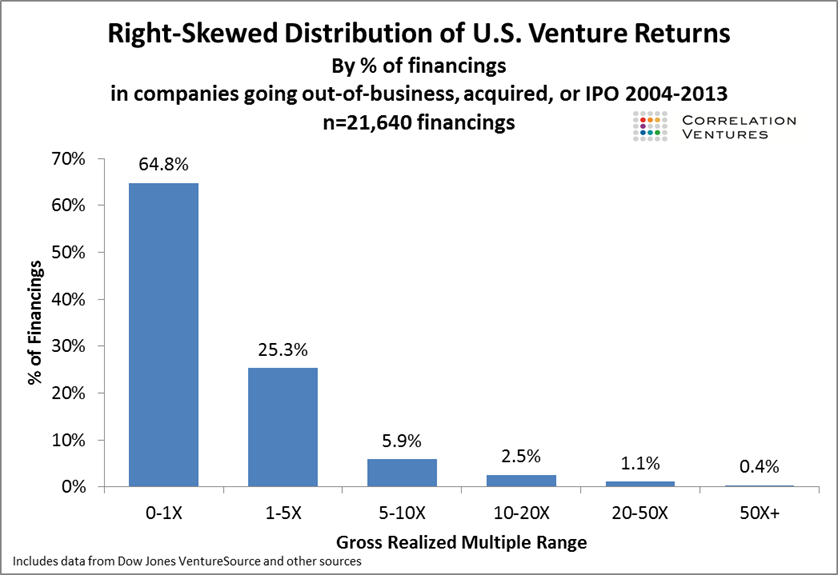
Actual access: Original linked chart downloaded and visually inspected; no raw dataset or detailed methods accessed.
Verified or reported finding used: 21,640 financings, not unique companies; 64.8% returned 0–1x, 25.3% 1–5x, 5.9% 5–10x, 2.5% 10–20x, 1.1% 20–50x and .4% 50x+. Book gives 2004–2014.
Limit: Gross multiples for exited financings, not net fund or investor returns; no venture-data reproduction.
Status / replication: Source chart recovered and uneven-return theme supported; unit/date distinctions retained.
Evidence family: VC.
S-GAL19 · Americans' Stress, Worry and Anger Intensified in 2018
Authors / responsible body: Gallup. Date / version: 2019 report on 2018 responses.
Source: https://news.gallup.com/poll/249098/americans-stress-worry-anger-intensified-2018.aspx
Actual access: Original poll report's relevant results read.
Verified or reported finding used: US stress 55% versus global 35%; worry 45% versus 39%, across 143 countries.
Limit: A dated cross-country snapshot, not a 1950-to-present trend or evidence that less time control caused unhappiness.
Status / replication: Official poll result; underlying respondent data not rerun.
Evidence family: GALLUP19.
S-PIL · Legacy Project: money advice from older Americans
Authors / responsible body: Karl Pillemer; Cornell University. Date / version: Author's qualitative research archive; publication dates vary.
Source: https://legacyproject.human.cornell.edu/category/money/
Actual access: Researcher's qualitative summary and extended excerpts read; transcripts and coding not audited.
Verified or reported finding used: Corroborates the reported emphasis on relationships/time rather than earning to compete with neighbors.
Limit: Retrospective advice is not representative prevalence or a causal comparison of optimal life strategies; income needed for a decent life is acknowledged.
Status / replication: Qualitative source attribution supported, not an experimental ranking.
Evidence family: PILLEMER.
S-GARCIA18 · The Status Signals Paradox
Authors / responsible body: Stephen M. Garcia; Kimberlee Weaver; Patricia Chen. Date / version: Online 2018; journal issue 2019; DOI 10.1177/1948550618783712.
Source: https://websites.umich.edu/~smgarcia/pubs/Status_Signals_Paradox.pdf
Actual access: Author-hosted paper downloaded; abstract, initial methods/results, final friendship/business comparison and discussion read. Raw data not rerun.
Verified or reported finding used: Six studies report a gap between presenters' expectations of status displays and prospective friends' interest; lower-status markers were preferred for friendship. Final business-versus-friendship comparison differed by purpose.
Limit: Business high-status advantage was marginal (p=.073), not decisive; friendship interaction was clearer. Not a direct test of attention to Ferrari versus driver, all luxury goods or deep respect.
Status / replication: Relevant pre-2020 support for Housel's caution, not an exact replication of luxury-label studies. No exhaustive integrity search claimed.
Evidence family: STATUS.
S-WILL10 · Normal weight men and women overestimate exercise energy expenditure
Authors / responsible body: Willbond; Laviolette; Duval; Doucet. Date / version: 2010; PMID 21178922.
Source: https://pubmed.ncbi.nlm.nih.gov/21178922/
Actual access: Original structured abstract read in full; complete paper not accessed.
Verified or reported finding used: Sixteen normal-weight adults completed 200/300-kcal treadmill bouts, estimated expenditure and were instructed to eat the caloric equivalent. Estimates were about 4.1/3.0 times expenditure; meal intake about 2.8/2.0 times.
Limit: Instructed matching is not spontaneous compensatory eating or evidence that most exercisers overeat. Canadian setting is not by itself a material scientific refutation of the phrase 'in America'.
Status / replication: Original numeric/task basis identified. Related studies use changed protocols, not exact replications; no matched retraction found in bounded search.
Evidence family: CALORIE.
S-HOLL14 · Matching energy intake to expenditure of isocaloric exercise at high- and moderate-intensities
Authors / responsible body: Adrian Holliday; Andrew K. Blannin. Date / version: 2014; DOI 10.1016/j.physbeh.2014.03.014.
Actual access: Published abstract and accepted manuscript's full main body read, including methods/results/discussion and parsed tables/captions; no visual figure audit or raw-data rerun.
Verified or reported finding used: Fourteen lean adults; moderate exercise expenditure underestimated (298 vs 443 kcal), matching-meal group means not significantly different from expenditure; unrestricted total intake about twice exercise expenditure.
Limit: Nonsignificance is not equivalence. Unrestricted total includes the matching meal. No no-exercise comparator; cannot infer extra intake caused by exercise. Some discussion values differ from abstract/results; use the latter.
Status / replication: Related pre-2020 task evidence with mixed estimation results and favorable substantial-eating evidence; not an exact replication.
Evidence family: CALORIE.
S-BROWN16 · Calorie Estimation in Adults Differing in Body Weight Class and Weight Loss Status
Authors / responsible body: Brown and colleagues. Date / version: 2016; DOI 10.1249/MSS.0000000000000796.
Source: https://mhrc.info.yorku.ca/files/2016/09/September-2016-Kuk.pdf
Actual access: Full main paper read through web PDF text, including methods/results/discussion and parsed tables/captions. Separate download failed certificate validation; no bypass. No visual figure or raw-data audit.
Verified or reported finding used: Fifty-eight adults; mean moderate estimates lacked the large earlier directional bias, but individual errors were substantial. Overweight non-weight-loss group overestimated vigorous expenditure by 72%. Forty-one elected unrestricted eating; most groups ate roughly twice exercise expenditure.
Limit: Participants assembled a matching meal without having to eat it. Overweight weight-loss group was an intake exception. No no-exercise comparator or daily-diet follow-up; meal total does not identify extra eating caused by exercise.
Status / replication: Related pre-2020 task evidence, not exact replication, retraction or proof that compensation never occurs.
Evidence family: CALORIE.
S-SCHUB13 · Acute exercise and subsequent energy intake: A meta-analysis
Authors / responsible body: Schubert and colleagues. Date / version: 2013; DOI 10.1016/j.appet.2012.12.010.
Source: https://pubmed.ncbi.nlm.nih.gov/23274127/
Actual access: Primary synthesis abstract read in full; complete methods, nested studies and data not reanalyzed.
Verified or reported finding used: 29 studies/51 trials; little acute absolute-intake increase and a relative energy deficit.
Limit: Not an exact calorie-estimation task replication; does not settle chronic compensation or every population.
Status / replication: Contextual contrary evidence for general acute compensation, not a refutation of matching-task arithmetic.
Evidence family: CALORIE.
S-EIA13 · U.S. energy intensity projected to continue its steady decline through 2040
Authors / responsible body: US Energy Information Administration. Date / version: March 1, 2013.
Source: https://www.eia.gov/todayinenergy/detail.php?id=10191
Actual access: Full original official article body read.
Verified or reported finding used: Energy per unit of GDP fell 58% from 1950 to 2011, attributed to efficiency and structural economic change.
Limit: The rounded historical 60% comparison is defensible; not all of the decline is technical efficiency, and 2040 is a forecast. Does not verify fleet/model-car comparisons.
Status / replication: Original book note 32 source recovered; no energy-data rerun.
Evidence family: EIA.
S-DYN04 · Do the Rich Save More?
Authors / responsible body: Karen E. Dynan; Jonathan Skinner; Stephen P. Zeldes. Date / version: NBER working paper 2000; JPE 2004; DOI 10.3386/w7906.
Source: https://www.nber.org/papers/w7906
Actual access: Primary working-paper abstract read; full methods/tables not audited.
Verified or reported finding used: Multiple household surveys show a positive association between lifetime income and saving rates.
Limit: Does not causally rank income against self-control, returns or ego; supports keeping income in the explanation.
Status / replication: Descriptive research, not a test of reading Housel or an independent wealth-building intervention.
Evidence family: SAVING.
S-MN17 · About depression babies and red diaper babies: Do macroeconomic experiences affect everybody's risk taking in the same way?
Authors / responsible body: Henning Cordes; Maik Dierkes. Date / version: March 2017; DOI 10.1016/j.jbef.2017.02.004.
Source: https://www.sciencedirect.com/science/article/pii/S2214635017300059
Actual access: Primary indexed results/conclusion excerpts read; full methods not inspected.
Verified or reported finding used: Related German evidence supports experience effects in the market-economy group and greater recency weighting. It did not generalize to those raised in former East Germany.
Limit: Different setting and sample; not an exact replication of the US SCF study.
Status / replication: Related supportive evidence; no independent data reanalysis.
Evidence family: MN-RELATED.
S-MN24 · What makes depression babies different: Expectations or preferences?
Authors / responsible body: Lejarraga; Woike; Hertwig. Date / version: 2024; DOI 10.1016/j.jbef.2024.100998.
Source: https://www.sciencedirect.com/science/article/pii/S2214635024001138
Actual access: Primary abstract and section excerpts read. Author-repository PDF download returned 403; full methods not audited.
Verified or reported finding used: Experimental experience effect found overall; corresponding belief/preference mechanism unclear and Study 3 did not clearly distinguish conditions.
Limit: Different task and population; not a replication of the 2007 household estimates or a causal wealth ranking.
Status / replication: Later related evidence, not a correction/retraction or independent rerun of the SCF data.
Evidence family: MN-RELATED.
S-QAL78 · Quality of American Life, 1978
Authors / responsible body: Angus Campbell; Philip E. Converse; ICPSR. Date / version: 1978 data; DOI 10.3886/ICPSR07762.v1.
Source: https://www.icpsr.umich.edu/web/ICPSR/studies/7762/publications
Actual access: Primary depositor catalogue description and methods read; codebook and data not obtained.
Verified or reported finding used: National multistage probability sample of 3,692 adults interviewed June–August 1978, partly overlapping 1971; includes perceived quality-of-life/control questions.
Limit: Does not identify the exact wave, scale, table or model behind Campbell's quoted comparison.
Status / replication: Methods context only, not a reconstruction of Campbell's analysis.
Evidence family: CAMP.
S-AIP · Past Climate Cycles: Ice Age Speculations
Authors / responsible body: Spencer Weart; American Institute of Physics. Date / version: Current accessed historical account; book note cites January 2020.
Source: https://history.aip.org/climate/cycles.htm
Actual access: Book's cited historical webpage opened and relevant historical explanation read; original core data not inspected.
Verified or reported finding used: Orbital changes and ice/snow feedback provide a real background for the analogy.
Limit: Distinguish Pleistocene cycles from older geological icehouses and Snowball Earth. Exact continental-ice timescale and storage chronology remain unverified; current page is not a frozen 2020 snapshot.
Status / replication: Historical scientific synthesis, not independent investment evidence.
Evidence family: CLIMATE.
S-CORNELL · Medallion Fund: The Ultimate Counterexample
Authors / responsible body: Bradford Cornell. Date / version: 2020 paper; author-uploaded version.
Actual access: Author-uploaded paper's indexed table excerpt only, not complete paper or Renaissance statements.
Verified or reported finding used: Reports annual average returns of 66.07% gross and 39.20% net.
Limit: Analysis of reported fund returns, not independent audited records or personal-wealth growth. Exact comparability to Buffett's 22% remains unresolved.
Status / replication: Reported-return context, not a fund-data reproduction.
Evidence family: MEDALLION.
S-CALC · Reviewer arithmetic and conditional accounting illustrations
Authors / responsible body: Draft preparer. Date / version: Executed during this review, evidence cutoff September 15, 2026.
Source: Supplied local material / reviewer calculation; no public URL asserted.
Actual access: Python Decimal/integer arithmetic executed; formulas and outputs included in appendix.
Verified or reported finding used: Audits internal arithmetic and hypothetical examples.
Limit: No empirical study, brokerage dataset, author backtest or simulation code was reproduced.
Status / replication: Deterministic calculation, not empirical replication.
Evidence family: CALC.
Complete numbered-note crosswalk
All 77 numbered entries below are transcribed from Housel’s notes. Their appearance here is not independent bibliographic or factual certification. This deliberately preserves sparse URLs, edition/date ambiguities and potentially incorrect descriptions rather than silently repairing the book. The substantive dossiers and source ledger record what was actually followed. In particular, note 48's underlying scientific paper was reviewed without claiming an independent reading of the TED transcript; note 4's exact August 2007 version has now been recovered and relevant methods/results read.
N01 — J. Pressler, “Former Merrill Lynch Executive Forced to Declare Bankruptcy Just to Keep a $14 Million Roof Over His Head,” New York magazine (April 9, 2010).
Bibliographic entry transcribed from the supplied book. Original referenced item not independently read; do not treat traceability, description or inference as certified.
Bibliographic entry transcribed from the supplied book. Original referenced item not independently read; do not treat traceability, description or inference as certified.
N03 — L. Thomas Jr., “The Tale of the $8 Million ‘Bargain’ House in Greenwich,” The New York Times (January 25, 2014).
Bibliographic entry transcribed from the supplied book. Original referenced item not independently read; do not treat traceability, description or inference as certified.
N04 — U. Malmendier, S. Nagel, “Depression Babies: Do Macroeconomic Experiences Affect Risk-Taking?” (August 2007).
Exact August 2007 author-hosted draft recovered; first draft December 2006. Relevant methods, weighting and stock/inflation-bond results read. Later versions are revisions, not independent replications. S-MN07.
N05 — “How large are 401(k)s?” Investment Company Institute (December 2019).
Bibliographic entry transcribed from the supplied book. Original referenced item not independently read; do not treat traceability, description or inference as certified.
N06 — R. Butler, “Retirement Pay Often Is Scanty,” The New York Times (August 14, 1955).
Bibliographic entry transcribed from the supplied book. Original referenced item not independently read; do not treat traceability, description or inference as certified.
N07 — “Higher education in the United States,” Wikipedia.
Book's Wikipedia entry is preserved, not retrospectively certified. Independent Census report summary and relevant indexed text show about one-third of adults 25+ held bachelor's degrees or higher in 2015, not one-quarter. S-CEN15.
N08 — K. Bancalari, “Private college tuition is rising faster than inflation .... again,” USA Today (June 9, 2017).
Bibliographic entry transcribed from the supplied book. Original referenced item not independently read; do not treat traceability, description or inference as certified.
N09 — “How Many People Die Rock Climbing?” The Rockulus.
Bibliographic entry transcribed from the supplied book. Original referenced item not independently read; do not treat traceability, description or inference as certified.
N10 — A. T. Vanderbilt II, Fortune’s Children: The Fall of the House of Vanderbilt (William Morrow Paperbacks, 2012).
Bibliographic entry transcribed from the supplied book. Original referenced item not independently read; do not treat traceability, description or inference as certified.
N11 — D. McDonald, “Rajat Gupta: Touched by scandal,” Fortune (October 1, 2010).
Bibliographic entry transcribed from the supplied book. Original referenced item not independently read; do not treat traceability, description or inference as certified.
N12 — “Did millionaire Rajat Gupta suffer from billionaire envy?” The Economic Times (March 27, 2011).
Bibliographic entry transcribed from the supplied book. Original referenced item not independently read; do not treat traceability, description or inference as certified.
N13 — J. Nicas, “Facebook Connected Her to a Tattooed Soldier in Iraq. Or So She Thought,” The New York Times (July 28, 2019).
Bibliographic entry transcribed from the supplied book. Original referenced item not independently read; do not treat traceability, description or inference as certified.
N14 — T. Maloney, “The Best-Paid Hedge Fund Managers Made $7.7 Billion in 2018,” Bloomberg (February 15, 2019).
Bibliographic entry transcribed from the supplied book. Original referenced item not independently read; do not treat traceability, description or inference as certified.
N15 — S. Weart, “The Discovery of Global Warming,” history.aip.org/climate/cycles.htm (January 2020). (January 2020).
Current cited AIP historical account opened and relevant explanation read; not a frozen January 2020 page. General orbital/ice-feedback background is supported; precise geological/continental-ice timescales remain qualified in B04-04. S-AIP.
N16 — S. Langlois, “From $6,000 to $73 billion: Warren Buffett’s wealth through the ages,” MarketWatch (January 6, 2017).
Bibliographic entry transcribed from the supplied book. Original referenced item not independently read; do not treat traceability, description or inference as certified.
N17 — D. Boudreaux, “Turnover in the Forbes 400, 2008–2013,” Cafe Hayek (May 16, 2014).
Bibliographic entry transcribed from the supplied book. Original referenced item not independently read; do not treat traceability, description or inference as certified.
N18 — M. Pabrai, www.youtube.com/watch?time_continue=200&v=YmmIbrKDYbw..
Bibliographic entry transcribed from the supplied book. Original referenced item not independently read; do not treat traceability, description or inference as certified.
N19 — “Art Dealers: The Other Vincent van Gogh,” Horizon Research Group (June 2010).
Bibliographic entry transcribed from the supplied book. Original referenced item not independently read; do not treat traceability, description or inference as certified.
N20 — www.collaborativefund.com/uploads/venture-returns.png
Original linked chart visually inspected: 21,640 exited financings in 2004–2013, gross return multiples. It supports uneven outcomes but not a unique-company count or 2004–2014 period. No raw venture-data reproduction. S-VC14.
N21 — “The Agony and the Ecstasy: The Risks and Rewards of a Concentrated Stock Position,” Eye on the Market, J.P. Morgan (2014).
Original JPM definitions, sector table and return distribution inspected. B06-01 also covers chapter 5's 'lost effectively all' wording. 'Never recovered' is a threshold clarification; catastrophic drawdown is not identical to zero value. B06-02 keeps the 7% classification distinct from all-index-return attribution.
N22 — L. Eadicicco, “Here’s Why You Probably Won’t Get Hired At Google,” Business Insider (October 23, 2014).
Bibliographic entry transcribed from the supplied book. Original referenced item not independently read; do not treat traceability, description or inference as certified.
N23 — “What is the offer acceptance rate for Facebook software engineering positions?” Quora.com..
Bibliographic entry transcribed from the supplied book. Original referenced item not independently read; do not treat traceability, description or inference as certified.
N24 — W. Fulton, “If You Want to Build a Great Team, Hire Apple Employees,” Forbes (June 22, 2012).
Bibliographic entry transcribed from the supplied book. Original referenced item not independently read; do not treat traceability, description or inference as certified.
N25 — J. Berger, “How to Change Anyone’s Mind,” The Wall Street Journal (February 21, 2020).
Bibliographic entry transcribed from the supplied book. Original referenced item not independently read; do not treat traceability, description or inference as certified.
N26 — D. Sivers, “How I got rich on the other hand,” sivers.org (October 30, 2019). (October 30, 2019).
Bibliographic entry transcribed from the supplied book. Original referenced item not independently read; do not treat traceability, description or inference as certified.
N27 — N. Chokshi, “Americans Are Among the Most Stressed People in the World, Poll Finds,” The New York Times (April 25, 2019).
NYT item itself not independently read. The underlying Gallup 2019 report's relevant 2018 results were read directly; the snapshot does not identify time control as a cause of long-run happiness change. S-GAL19.
N28 — Russell Sage Foundation—Chartbook of Social Inequality.
Bibliographic entry transcribed from the supplied book. Original referenced item not independently read; do not treat traceability, description or inference as certified.
N29 — D. Thompson, “Why White-Collar Workers Spend All Day at the Office,” The Atlantic (December 4, 2019).
Bibliographic entry transcribed from the supplied book. Original referenced item not independently read; do not treat traceability, description or inference as certified.
N30 — “Rihanna’s ex-accountant fires back,” News24 (March 24, 2014).
Bibliographic entry transcribed from the supplied book. Original referenced item not independently read; do not treat traceability, description or inference as certified.
N31 — B. Mann, “Want to Get Rich and Stay Rich?” The Motley Fool (March 7, 2017).
Mann's financial maxim is the note's subject; the original item was not independently read. This is not a primary citation for the nearby Bryson exercise quotation. The identified exercise study and related evidence are separately recorded in B09-03.
N32 — “U.S. energy intensity projected to continue its steady decline through 2040,” U.S. Energy Information Administration (March 1, 2013).
Original official EIA article read in full: 58% energy/GDP decline in 1950–2011, from efficiency and structural change. Later 2040 numbers are projections. Vehicle comparisons remain unverified. S-EIA13.
N33 — Julius Wagner-Jauregg—Biographical, nobelprize.org..
Bibliographic entry transcribed from the supplied book. Original referenced item not independently read; do not treat traceability, description or inference as certified.
N34 — J. M. Cavaillon, “Good and bad fever,” Critical Care 16:2 (2012).
Bibliographic entry transcribed from the supplied book. Original referenced item not independently read; do not treat traceability, description or inference as certified.
N35 — “Fever—Myths Versus Facts,” Seattle Children’s.
Bibliographic entry transcribed from the supplied book. Original referenced item not independently read; do not treat traceability, description or inference as certified.
N36 — J. J. Ray, and C. I. Schulman, “Fever: suppress or let it ride?” Journal of Thoracic Disease 7:12 (2015).
Bibliographic entry transcribed from the supplied book. Original referenced item not independently read; do not treat traceability, description or inference as certified.
N37 — A. LaFrance, “A Cultural History of the Fever,” The Atlantic (September 16, 2015).
Bibliographic entry transcribed from the supplied book. Original referenced item not independently read; do not treat traceability, description or inference as certified.
N38 — J. Zweig, “What Harry Markowitz Meant,” jasonzweig.com (October 2, 2017). (October 2, 2017).
Bibliographic entry transcribed from the supplied book. Original referenced item not independently read; do not treat traceability, description or inference as certified.
N39 — L. Pleven, “In Bogle Family, It’s Either Passive or Aggressive,” The Wall Street Journal (November 28, 2013).
Bibliographic entry transcribed from the supplied book. Original referenced item not independently read; do not treat traceability, description or inference as certified.
N40 — C. Shapiro and M. Housel, “Disrupting Investors’ Own Game,” The Collaborative Fund.
Bibliographic entry transcribed from the supplied book. Original referenced item not independently read; do not treat traceability, description or inference as certified.
N41 — www.bylo.org
Bibliographic entry transcribed from the supplied book. Original referenced item not independently read; do not treat traceability, description or inference as certified.
N42 — Washington State University, “For pundits, it’s better to be confident than correct,” ScienceDaily (May 28, 2013).
Bibliographic entry transcribed from the supplied book. Original referenced item not independently read; do not treat traceability, description or inference as certified.
N43 — “Daniel Kahneman’s Favorite Approach For Making Better Decisions,” Farnham Street (January 2014).
Bibliographic entry transcribed from the supplied book. Original referenced item not independently read; do not treat traceability, description or inference as certified.
N44 — W. Buffett, Letter to the Shareholders of Berkshire Hathaway Inc. (2008).
Bibliographic entry transcribed from the supplied book. Original referenced item not independently read; do not treat traceability, description or inference as certified.
N45 — W. Buffett, Letter to the Shareholders of Berkshire Hathaway Inc. (2006).
Bibliographic entry transcribed from the supplied book. Original referenced item not independently read; do not treat traceability, description or inference as certified.
N46 — B. Plumer, “Only 27 percent of college grads have a job related to their major,” The Washington Post (May 20, 2013).
Bibliographic entry transcribed from the supplied book. Original referenced item not independently read; do not treat traceability, description or inference as certified.
N47 — G. Livingston, “Stay-at-home moms and dads account for about one-in-five U.S. parents,” Pew Research Center (September 24, 2018).
Bibliographic entry transcribed from the supplied book. Original referenced item not independently read; do not treat traceability, description or inference as certified.
N48 — D. Gilbert, “The psychology of your future self,” TED2014.
Book cites a 2014 TED talk. Underlying 2013 research and subsequent exchange inspected; the TED transcript itself was not independently checked.
N49 — J. Zweig, “What I Learned From Daniel Kahneman,” jasonzweig.com (March 30, 2014). (March 30, 2014).
Bibliographic entry transcribed from the supplied book. Original referenced item not independently read; do not treat traceability, description or inference as certified.
N50 — J. Ptak “Tactical Funds Miss Their Chance,” Morningstar (February 2, 2012).
Indexed original article excerpts support the nine-of-112 Sharpe-ratio comparison for the selected interval. Complete report and separate drawdown proportion remain unverified. See S-PTAK12.
N51 — R. Kinnel, “Mind the Gap 2019,” Morningstar (August 15, 2019).
Indexed original opening reports a 45-basis-point average gap; full tables and exact equity-fund universe not recovered. Do not infer that all money-weighted differences are avoidable mistakes. See S-KIN19.
N52 — M. Desmond. “Accounting Tricks Catch Up With GE,” Forbes (August 4, 2009).
The Forbes article itself was not independently read. Primary SEC release and complaint passages date the cited locomotive transactions to 2002/2003, after Welch’s departure. See S-GE09.
N53 — A. Berenson, “Freddie Mac Says It Understated Profits by Up to $6.9 Billion,” The New York Times (June 25, 2003).
The cited Freddie Mac newspaper report remains unread. An independent primary OFHEO release supports earnings smoothing at Fannie Mae but reports overstatement, not the same underreporting direction. See S-FANNIE06.
N54 — “U.S. Home Flipping Rate Reaches a Nine-Year High in Q1 2019,” Attom Data Solutions (June 4, 2019).
Bibliographic entry transcribed from the supplied book. Original referenced item not independently read; do not treat traceability, description or inference as certified.
N55 — A. Osborn, “As if Things Weren’t Bad Enough, Russian Professor Predicts End of U.S.,” The Wall Street Journal (December 29, 2008).
Bibliographic entry transcribed from the supplied book. Original referenced item not independently read; do not treat traceability, description or inference as certified.
N56 — “Food in the Occupation of Japan,” Wikipedia.
Bibliographic entry transcribed from the supplied book. Original referenced item not independently read; do not treat traceability, description or inference as certified.
N57 — J. M. Jones, “U.S. Stock Ownership Down Among All but Older, Higher-Income,” Gallup (May 27, 2017).
Cited Gallup report accessed; actual date May 24, 2017 rather than book’s May 27. Measurement mismatch documented.
N58 — E. Rauchway, The Great Depression and the New Deal: A Very Short Introduction (Oxford University Press, 2008).
Bibliographic entry transcribed from the supplied book. Original referenced item not independently read; do not treat traceability, description or inference as certified.
N59 — L. R. Brown, Plan B 3.0: Mobilizing to Save Civilization (W. W. Norton & Company, 2008).
Original preface and China/oil passage read. Demand is conditional on continued growth and US-style consumption, and Brown advocates adaptation; Housel retains the scenario qualifier. See S-BROWN08.
N60 — FRED, Federal Reserve Bank of St. Louis.
Bibliographic entry transcribed from the supplied book. Original referenced item not independently read; do not treat traceability, description or inference as certified.
N61 — “U.S. Crude Oil Production—Historical Chart,” Macro Trends.
Bibliographic entry transcribed from the supplied book. Original referenced item not independently read; do not treat traceability, description or inference as certified.
N62 — “Thomas Selfridge,” Wikipedia.
Bibliographic entry transcribed from the supplied book. Original referenced item not independently read; do not treat traceability, description or inference as certified.
N63 — www.nhlbi.nih.gov
Bibliographic entry transcribed from the supplied book. Original referenced item not independently read; do not treat traceability, description or inference as certified.
N64 — D. Walsh, “The Tragedy of Saudi Arabia’s War,” The New York Times (October 26, 2018).
Bibliographic entry transcribed from the supplied book. Original referenced item not independently read; do not treat traceability, description or inference as certified.
N65 — B. Pisani, “Active fund managers trail the S&P 500 for the ninth year in a row in triumph for indexing,” CNBC (March 15, 2019).
CNBC article and revision history not independently read. The underlying SPIVA 2018 table supports the rounded figure for specified US equity categories and benchmarks, not an unrestricted all-active-fund claim. See S-SPIVA18.
N66 — 2019 Investment Company Factbook, Investment Company Institute.
Bibliographic entry transcribed from the supplied book. Original referenced item not independently read; do not treat traceability, description or inference as certified.
N67 — “Minutes of the Federal Open Market Committee,” Federal Reserve (October 30–31, 2007).
Original Table 1 and footnotes, downside-risk discussion and uncertainty explanation read. Cross-participant ranges are not worst-case bounds; GDP is fourth-quarter-over-fourth-quarter. Matched actual GDP vintages remain unreconciled. See S-FOMC07.
N68 — www.nasa.gov
Bibliographic entry transcribed from the supplied book. Original referenced item not independently read; do not treat traceability, description or inference as certified.
N69 — A. Ram, “Portfolio managers shun investing in own funds,” Financial Times (September 18, 2016).
Bibliographic entry transcribed from the supplied book. Original referenced item not independently read; do not treat traceability, description or inference as certified.
N70 — K. Murray “How Doctors Die,” Zócalo Public Square (November 30, 2011).
Substantial indexed text of a later essay republication read; original Zócalo page not recovered. It is an experience-based essay, not a designed comparison. Later cohorts provide mixed, outcome-specific evidence and do not test advice given to the same doctors’ patients. See S-MUR11, S-MAT16, S-WEI16.
N71 — B. Pisani, “Active fund managers trail the S&P 500 for the ninth year in a row in triumph for indexing,” CNBC (March 15, 2019).
Same March 15, 2019 article as note 65; chapter 20 describes a decade ending 2019. Underlying March 2019 SPIVA report covers a decade ending 2018. CNBC revision history remains unchecked, so the citation/date mismatch is not treated as fully resolved. See S-SPIVA18.
N72 — “Treasury-Fed Accord,” federalreservehistory.org..
Bibliographic entry transcribed from the supplied book. Original referenced item not independently read; do not treat traceability, description or inference as certified.
N73 — S. Garon, “Beyond Our Means: Why America Spends While the World Saves,” Federal Reserve Bank of St. Louis (July 1, 2012).
Bibliographic entry transcribed from the supplied book. Original referenced item not independently read; do not treat traceability, description or inference as certified.
N74 — “Economic Report of the President,” FRASER, St. Louis Federal Reserve (1951).
Bibliographic entry transcribed from the supplied book. Original referenced item not independently read; do not treat traceability, description or inference as certified.
N75 — P. Graham, “The Refragmentation,” paulgraham.com (2016). (2016).
Bibliographic entry transcribed from the supplied book. Original referenced item not independently read; do not treat traceability, description or inference as certified.
N76 — P. Davidson, “Jobs in high-wage industries are growing fastest,” USA Today (December 14, 2019).
Bibliographic entry transcribed from the supplied book. Original referenced item not independently read; do not treat traceability, description or inference as certified.
N77 — R. Channick, “Average college costs flat nationwide, at just under $15K, as universities increase grants,” Chicago Tribune (October 16, 2018).
Bibliographic entry transcribed from the supplied book. Original referenced item not independently read; do not treat traceability, description or inference as certified.
12 · Notices and corrections
Editorial status. Prepared for The Behavioral Scientist at Jason Hreha’s direction. The review was prepared with AI assistance. No independent human scientific sign-off or author response is claimed.
Research process. How we research and score these reviews explains the shared research process. This appendix records the book-specific evidence and verification limits. No independent human scientific sign-off or legal clearance is claimed.
Scientific responsibility. Findings are attributed to the researchers or official source bodies. No study is presented as work conducted by Jason Hreha or the review preparer. Arithmetic checks are identified as such; they are not participant-level replications. An inaccessible source is not called fabricated. No misconduct or private motive is inferred from an error, source problem or disagreement.
Relevant interests. Jason Hreha states that he has no personal, professional or financial relationship with Morgan Housel or Harriman House, and no sponsorship connected to this book. This is his declaration, not an independent investigation of interests. He also has a commercially available book, Real Change, and offers behavioral-science services.
Publication and contact. The Behavioral Scientist. See the shared editorial notice and corrections policy for publisher information and contact details.
Responses and corrections. No author or publisher response to this review was requested or received in this assignment. The absence of a response is not assent. Proposed corrections should identify the book edition, chapter/passage, source and exact replacement. Internal first-draft changes are not public updates. After first publication, substantive factual corrections, new evidence and changed editorial judgments should be distinguished and dated under the verified shared corrections policy.
Use. The review evaluates a book; it is not individualized financial, medical, legal or tax advice. The method’s provenance and relationship to other review services belong in the shared methodology rather than repeated disclaimers in the reader essay. No claim of affiliation, endorsement, safety certification or measured reader outcome is made.