What Is the Fogg Behavior Model?
The Fogg Behavior Model (FBM) states that behavior occurs when three elements converge at the same moment: Motivation (M), Ability (A), and a Prompt (P). The formula is B = MAP. If any element is missing or insufficient, the behavior does not occur. Developed by BJ Fogg at Stanford University’s Persuasive Technology Lab (now the Behavior Design Lab), the model was first published in 2009 at the Persuasive Technology conference and later expanded in Fogg’s 2019 book Tiny Habits: The Small Changes That Change Everything.
The model’s central design insight: increasing Ability (making the behavior easier) is almost always more effective and more sustainable than trying to increase Motivation. Motivation fluctuates. Simplicity is stable.
FBM has been one of the most influential frameworks in product design and technology, partly because of Fogg’s Stanford teaching. Former students include Instagram co-founder Mike Krieger, Hooked author Nir Eyal, and Center for Humane Technology founder Tristan Harris.
The Three Components
Motivation: The Energy Behind Behavior
Fogg identifies three core motivator pairs, each operating on a spectrum:
- Sensation: Pleasure / Pain (immediate physical or emotional response)
- Anticipation: Hope / Fear (expectation of future outcomes)
- Belonging: Social Acceptance / Social Rejection (desire for connection)
Fogg’s distinctive claim: motivation is the least reliable lever for behavior change. It comes in waves. People experience spikes of motivation (after New Year’s, a health scare, an inspiring talk) that inevitably recede. Designing for high motivation is therefore fragile. The “motivation wave” peaks and crashes. A system that depends on sustained motivation will fail when the wave recedes.
This is a direct challenge to motivational approaches. Rather than trying to pump up motivation (which traditional behavior change campaigns, health education, and inspirational messaging attempt), Fogg argues that designers should accept motivation as unreliable and instead make the behavior so easy that even low-motivation moments cannot stop it.
Ability: The Simplicity Chain
Fogg defines ability not as skill but as simplicity. A behavior’s “ability” is determined by six factors, any one of which can block action:
- Time. The behavior takes too long.
- Money. The behavior costs too much.
- Physical Effort. Too physically demanding.
- Mental Effort. Requires too much thinking or cognitive load.
- Social Deviance. Goes against social norms.
- Non-Routine. Disrupts existing habits or patterns.
The simplicity chain works like any chain: it is only as strong as its weakest link. For different people in different contexts, different factors will be the bottleneck. A behavior might be fast, free, and physically easy, but if it requires high mental effort (complex tax forms), many people will not complete it. Identifying and addressing the specific bottleneck factor is the core design task.
Prompt: The Trigger to Act
Originally called “Trigger” in the 2009 paper (B = MAT), Fogg renamed this element “Prompt” in the 2019 book because “trigger” had acquired negative connotations. The prompt is what tells the person “do this behavior now.”
Three types of prompts, matched to where a person falls on the motivation-ability landscape:
Spark. For someone with high ability but low motivation. The prompt must simultaneously motivate. Example: an inspirational video with a call to action. The prompt itself carries motivational content.
Facilitator. For someone with high motivation but low ability. The prompt must simultaneously make the behavior easier. Example: a one-click donation button for someone who already wants to donate. The prompt removes friction.
Signal. For someone with both sufficient motivation and sufficient ability. They just need a reminder. Example: a calendar notification for someone who wants to and can attend a meeting.
The Action Line
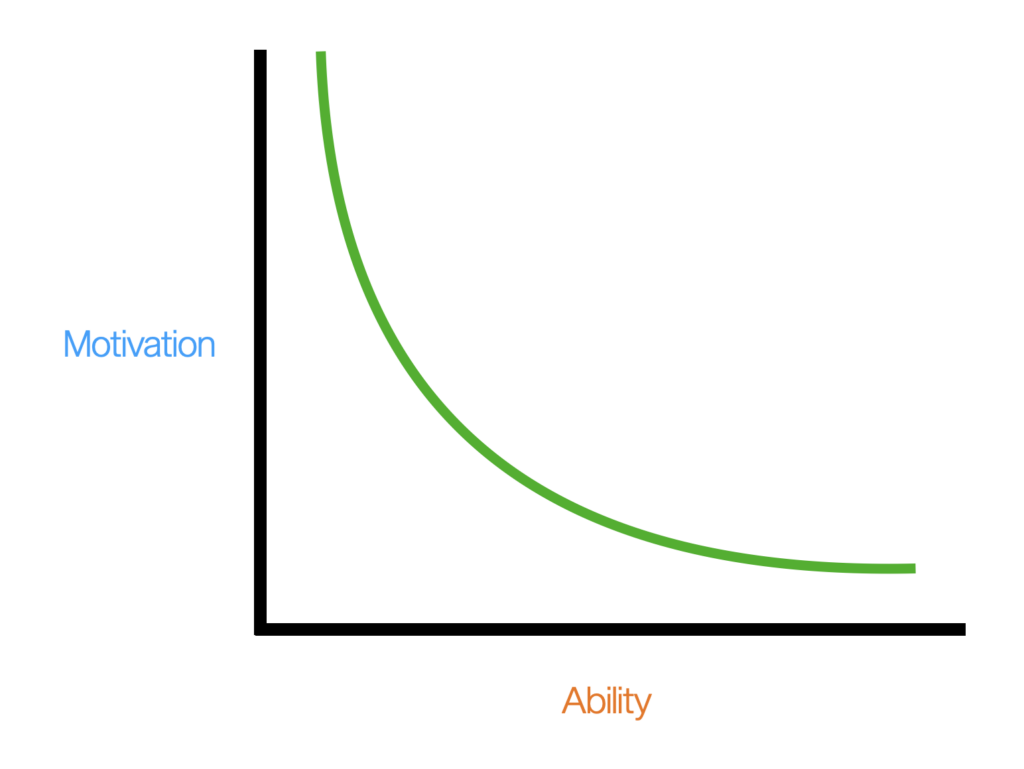
The FBM visualizes behavior on a graph. The X-axis is Ability (from hard to easy). The Y-axis is Motivation (from low to high). A curved line (the “action line”) separates behaviors that happen from those that do not.
Above the line, a well-timed prompt produces behavior. Below the line, even the best prompt fails. The curve shows a tradeoff: very high motivation can compensate for low ability (people will do hard things when desperate), and very high ability can compensate for low motivation (people will do trivially easy things even when barely motivated).
The practical design implication: move people above the action line by either boosting motivation OR increasing ability. Fogg’s argument is that increasing ability is the more reliable move.
Tiny Habits: The Applied Method
Fogg’s 2019 book Tiny Habits operationalizes the FBM into a specific behavior change recipe:
“After I [ANCHOR MOMENT], I will [TINY BEHAVIOR]. Then I celebrate.”
Three components:
Anchor Moment. An existing routine or event that reliably occurs. “After I pour my morning coffee.” “After I sit down at my desk.” “After I flush the toilet.” The anchor serves as the Prompt in B = MAP.
Tiny Behavior. The new habit, scaled down to its absolute smallest version. The rule: it should take less than 30 seconds and require almost no motivation. Instead of “do 50 pushups,” do 2. Instead of “meditate for 20 minutes,” take 3 deep breaths. Instead of “floss all my teeth,” floss one tooth.
Celebration. An immediate positive emotion after performing the tiny behavior. Saying “Victory!” to yourself. A small fist pump. A genuine smile. Fogg calls this “Shine” and argues it is the most important and most overlooked element, because the positive emotion creates a neurological association that wires in the habit.
Fogg’s central claim: emotions create habits, not repetition. This contrasts with the popular “21 days to form a habit” myth and even with Phillippa Lally’s more rigorous UCL study (2010, European Journal of Social Psychology), which found habit formation takes an average of 66 days (range: 18 to 254). Fogg argues that a single instance of a behavior, accompanied by a strong positive emotion, can begin to wire the habit pathway.
Over 40,000 people completed Fogg’s free 5-day Tiny Habits program before the book’s publication, with self-reported success rates around 80% for adopting at least one new habit. These are self-reported figures from Fogg’s own program, not independently verified in a peer-reviewed study.
Real-World Applications
Product Design and Silicon Valley
The FBM’s largest influence has been in technology product design. Fogg’s Stanford class (CS 377W, originally called “Creating Engaging Facebook Apps”) taught students to apply persuasive technology principles. The class produced several notable ventures:
Instagram. Co-founder Mike Krieger took Fogg’s class. Instagram was designed with extreme simplicity (one core action: take photo, apply filter, share), aligning with FBM’s emphasis on maximizing Ability. Social feedback (likes, comments) served as both motivation and prompts for continued use. Instagram launched in October 2010 and reached 1 million users in 2 months.
The Hooked Model. Nir Eyal, influenced by Fogg’s work, published Hooked: How to Build Habit-Forming Products in 2014. The Hook Model (Trigger, Action, Variable Reward, Investment) is explicitly built on FBM concepts and has been adopted widely in product design at companies like Pinterest and Slack.
Health Behavior
FBM has been applied as a design framework for health interventions, particularly in mobile health (mHealth) applications. Guo and colleagues (2020) used FBM to design a physical activity intervention, published in JMIR mHealth and uHealth. Most published studies use FBM as a design framework rather than testing the model’s predictions directly.
The Ethics Debate
Tristan Harris, also a student in Fogg’s lab, became one of the most prominent critics of attention-economy design. After working as Google’s “Design Ethicist,” Harris founded the Center for Humane Technology (originally “Time Well Spent”) and appeared in the Netflix documentary The Social Dilemma (2020). His critique: the same persuasive design principles Fogg taught were being used by tech companies to create addictive products that exploit vulnerability rather than serve wellbeing.
Fogg responded by renaming his lab from “Persuasive Technology Lab” to “Behavior Design Lab” (around 2011, with the shift fully completed by 2018) and emphasizing that behavior design should be used for good. The tension between FBM as a tool for positive behavior change and FBM as the intellectual foundation of addictive technology design remains unresolved.
Limitations and Criticisms
Limited peer-reviewed validation. The 2009 FBM paper is a conference paper, not a journal article with full peer review in a behavioral science journal. Despite over 2,000 citations, most citing papers apply the model as a design framework rather than test its predictions empirically. There are no published randomized controlled trials directly testing FBM’s core predictions.
Oversimplification. The model collapses complex behavioral determinants into three broad categories. COM-B (Michie, van Stralen, & West, 2011) distinguishes between reflective and automatic motivation. FBM does not. COM-B includes social and physical opportunity as explicit components. FBM folds environmental factors into “Ability.” For population-level health behavior change requiring comprehensive diagnosis, COM-B provides substantially more structure.
Handles simple behaviors better than complex ones. FBM works well for one-time actions or simple daily habits (flossing, doing pushups, opening an app). It is less effective for complex, multi-step, socially embedded behaviors (changing organizational culture, managing chronic disease, addressing systemic health disparities). It does not account for structural and environmental constraints (poverty, access, systemic inequality) that shape behavior independent of individual motivation or ability.
The celebration mechanism is unverified. Fogg claims emotions create habits more effectively than repetition. The neurological mechanism (dopamine release from self-celebration) is his interpretation. No peer-reviewed study has specifically tested whether self-celebration after a tiny behavior accelerates habit formation compared to a no-celebration control.
Motivation as unreliable. Fogg’s dismissal of motivation as a design lever works for product design contexts (where you want frictionless engagement) but is less applicable to behaviors that genuinely require sustained high motivation: quitting addiction, major career changes, persisting through physical rehabilitation. The model does not address intrinsic versus extrinsic motivation (a distinction central to Self-Determination Theory, Deci and Ryan) or motivational conflict.
FBM vs. Other Frameworks
| Feature | FBM (Fogg) | COM-B (Michie) | Habit Loop (Duhigg) | Atomic Habits (Clear) |
|---|---|---|---|---|
| Formula | B = MAP | C + O + M = B | Cue, Routine, Reward | 4 Laws |
| Key lever | Make it easy | Diagnose all components | Modify the routine | Identity change |
| Motivation | Unreliable, minimize dependence | Reflective + Automatic (both matter) | Craving drives the loop | “Make it attractive” |
| Environment | Folded into Ability | Explicit (Opportunity) | Not modeled | “Make it obvious” |
| Academic basis | Conference paper, 2,000+ citations | Journal paper, 15,000+ citations | Journalistic synthesis | Self-help synthesis |
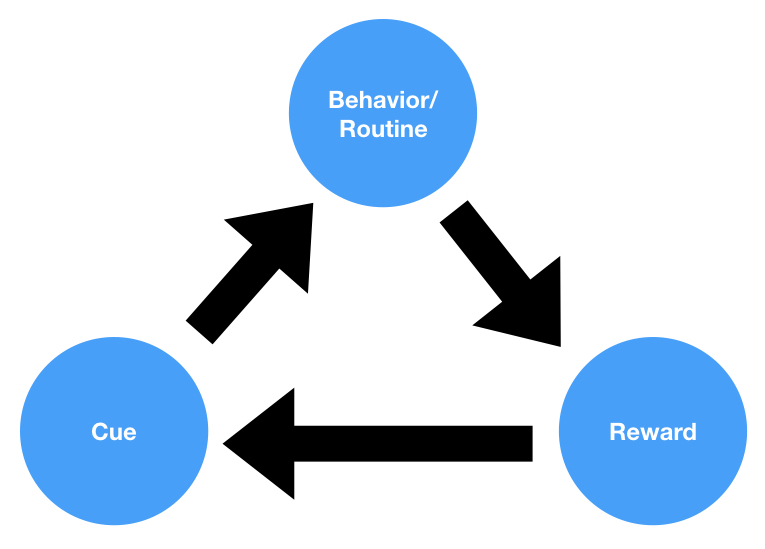
| Best for | Product design, habit initiation | Health interventions, policy | Understanding existing habits | Personal development |
Frequently Asked Questions
What is the Fogg Behavior Model? The Fogg Behavior Model (FBM) states that behavior occurs when three elements converge simultaneously: Motivation (the desire to act), Ability (the ease of acting), and a Prompt (a cue that says “do it now”). The formula is B = MAP. If any element is missing, the behavior does not occur. The model was developed by BJ Fogg at Stanford University and first published in 2009.
What is the difference between B=MAT and B=MAP? B = MAT (Motivation, Ability, Trigger) was the original 2009 formulation. B = MAP (Motivation, Ability, Prompt) is the updated version from Fogg’s 2019 book Tiny Habits. The only change is the term: “Trigger” was replaced with “Prompt” because Fogg felt “trigger” had acquired negative connotations.
What is a Tiny Habit? A Tiny Habit is a behavior scaled down to its smallest possible version, anchored to an existing routine, and followed by an immediate celebration. The recipe format is: “After I [anchor moment], I will [tiny behavior].” For example: “After I pour my morning coffee, I will do 2 pushups.” The behavior should take less than 30 seconds and require almost no motivation.
How does the Fogg Behavior Model compare to COM-B? Both identify motivation and capability/ability as key factors. The differences: COM-B distinguishes between reflective and automatic motivation, which FBM does not. COM-B includes Opportunity (environmental and social factors) as a separate component, while FBM folds environmental factors into Ability. COM-B provides a systematic intervention design pathway (the Behaviour Change Wheel). FBM provides design heuristics. COM-B is the more rigorous academic framework. FBM is more intuitive for product designers.
Is the Fogg Behavior Model evidence-based? The model is based on established behavioral science principles (motivation research, friction effects, cueing). However, the FBM itself has not been validated through randomized controlled trials testing its specific predictions. The original 2009 paper is a conference paper, not a peer-reviewed journal article. Most academic citations use FBM as a design framework rather than testing it as a scientific theory.
Sources and Further Reading
- Fogg, B. J. (2009). A Behavior Model for Persuasive Design. Proceedings of the 4th International Conference on Persuasive Technology, Article 40. ACM.
- Fogg, B. J. (2019). Tiny Habits: The Small Changes That Change Everything. Houghton Mifflin Harcourt.
- Michie, S., van Stralen, M. M., & West, R. (2011). The behaviour change wheel. Implementation Science, 6, 42.
- Lally, P., van Jaarsveld, C. H. M., Potts, H. W. W., & Wardle, J. (2010). How are habits formed. European Journal of Social Psychology, 40(6), 998-1009.
- Eyal, N. (2014). Hooked: How to Build Habit-Forming Products. Portfolio/Penguin.
- Guo, Y., et al. (2020). Using the internet of things-based smartphone app to create a physical activity intervention for health. JMIR mHealth and uHealth, 8(2), e16134.
- Tversky, A., & Kahneman, D. (1979). Prospect theory: An analysis of decision under risk. Econometrica, 47(2), 263-291.
- Deci, E. L., & Ryan, R. M. (2000). The “what” and “why” of goal pursuits. Psychological Inquiry, 11(4), 227-268.